

Rooftop Solar in Chennai: Monsoon Considerations and Costs (2026 Guide)
Chennai is a city of extremes—from the scorching "Agni Natchathiram" heat in May to the relentless downpours of the Northeast Monsoon in November. For a Chennai homeowner, investing in rooftop solar isn't just about saving on TANGEDCO bills; it’s about choosing a system that can withstand coastal salt air and heavy rains.
In 2026, with electricity tariffs rising and the PM Surya Ghar Muft Bijli Yojana providing up to ₹78,000 in subsidy, rooftop solar has become a common sight from Adyar to Ambattur. But many ask: "Does solar work during our heavy November rains?" and "Is the coastal air going to rust my panels?" This comprehensive guide breaks down the 2026 costs, subsidies, and essential monsoon tips specifically for the Chennai climate.
1. The "Chennai Monsoon" Factor: Generation Reality
Unlike most of India which relies on the June-September monsoon, Chennai gets its heaviest rain during the Northeast Monsoon (October–December).
Will my panels produce power in the rain?
Yes. Solar panels don't need direct "hot" sunlight; they need light. On a typical rainy day in Velachery, your system will still produce about 20-30% of its normal capacity from diffused light.
The Annual Balance
While generation dips in November, Chennai’s high solar irradiance from January to September more than compensates for it. On an annual basis, a 1kW system in Chennai produces roughly 1,450–1,550 units, which is among the highest in India.
Key Stat: Even in the cloudiest November, a 5kW system in Chennai typically produces over 400 units, ensuring your essential loads stay covered.
2. Rooftop Solar Costs in Chennai (April 2026)
With the maturity of the local market, solar prices in Chennai have stabilized. Below is the estimated cost breakdown for on-grid systems in Chennai, including the PM Surya Ghar subsidy.
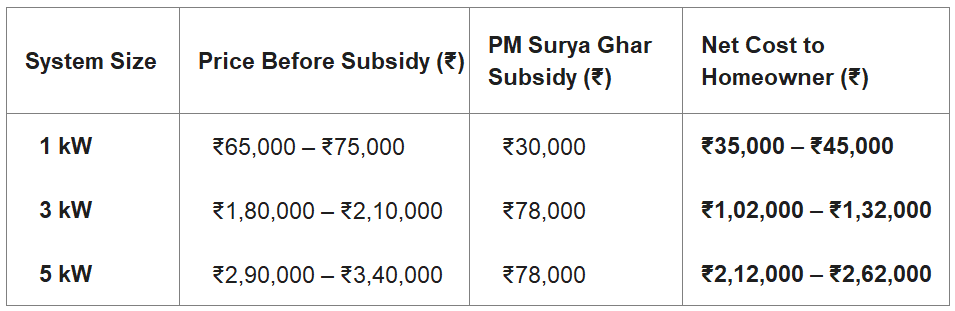
Note: Prices include installation, net meter, and standard structure. Additional costs may apply for high-rise apartments or special "stilt" structures.
3. TANGEDCO Net Metering & 2026 Policy
To get the maximum benefit in Chennai, you must opt for Net Metering. This allows you to "store" the excess energy you produce in the morning into the TANGEDCO grid and use it back at night for your AC.
- Sanctioned Load Rule: Your solar capacity cannot exceed your home's sanctioned load. If you have a 3kW connection, you can only install up to 3kW of solar.
- Carry-Forward: Surplus energy in a sunny month (like April) is carried forward to your next bill, helping you offset higher consumption during the humid monsoon months.
- Settlement: At the end of the settlement period, TANGEDCO pays for excess units at an "Avoided Cost" rate (approx. ₹2.50 – ₹3.00 per unit).
4. Monsoon Maintenance Checklist for Chennai Homeowners
The combination of heavy rain and salty coastal wind requires specific maintenance to ensure your system lasts 25 years.
- Check Your Earthing: Chennai experiences heavy lightning during monsoon transitions. Ensure your LA (Lightning Arrester) and earthing pits are active.
- Cleaning After Rain: While rain washes away dust, the sticky "sea salt" film in coastal areas (OMR, ECR, Besant Nagar) can become a mud-like layer when it dries. Lightly rinse your panels after the first few rains.
- Trim Overhanging Trees: During the "Vardah" or "Michaung" like storms, nearby branches are the biggest threat to panels. Prune any trees that could fall or scrape the glass.
- Structure Coating: Ensure your mounting structure is Hot-Dip Galvanized. Non-galvanized iron will rust within two Chennai monsoons due to high salinity.
5. Best Solar Brands for Chennai's Coastal Climate
In 2026, choose brands that are ALMM-approved and have high resistance to Salt Mist Corrosion (IEC 61701 certified).
- Tata Power Solar: Excellent local service network in Tamil Nadu.
- Waaree Energies: High-efficiency Mono PERC panels that perform well in low light.
- Adani Solar: Known for robust build quality suitable for coastal wind speeds.
- Loom Solar: Great for smaller residential rooftops in crowded areas like T-Nagar.
Conclusion: Is Solar Worth It in Chennai?
Absolutely. Despite the 3 months of monsoon, the ROI (Return on Investment) for a Chennai homeowner is typically reached within 4 to 5 years. With the ₹78,000 subsidy available in 2026, your "payback" happens even faster.


