

Best Solar Inverters in India 2026: String vs Hybrid vs Micro – Which One is Right for Your Home?
You've finally decided to go solar. You've calculated your system size, compared panel brands like Waaree and Tata, and even checked your eligibility for the PM Surya Ghar subsidy. But there's one critical component most homeowners overlook until the last minute: the solar inverter.
Think of solar panels as the engine and the inverter as the brain. It converts the DC electricity your panels generate into usable AC power for your fans, lights, and ACs. Choose the wrong one, and you could be sitting in the dark during a power cut while your panels are generating electricity under the bright sun.
In this guide, we'll compare the three main types of solar inverters available in India in 2026: String, Hybrid, and Microinverters. We'll look at their costs in rupees, their performance during power cuts, and help you decide which one is the best fit for your home.
What Does a Solar Inverter Do? (A Quick Refresher)
If you're new to solar, here's a simple explanation. Your solar panels generate electricity in Direct Current (DC). Your home appliances run on Alternating Current (AC). The inverter's job is to convert DC to AC.
But modern inverters do much more. They also:
- Manage the flow of electricity between your panels, your home, the grid, and your batteries (if you have them).
- Monitor system performance and alert you to issues.
- Ensure safety by automatically disconnecting during grid failures (for standard on-grid systems).
The Three Contenders: String, Hybrid, and Microinverters
Let's break down each type in simple terms.
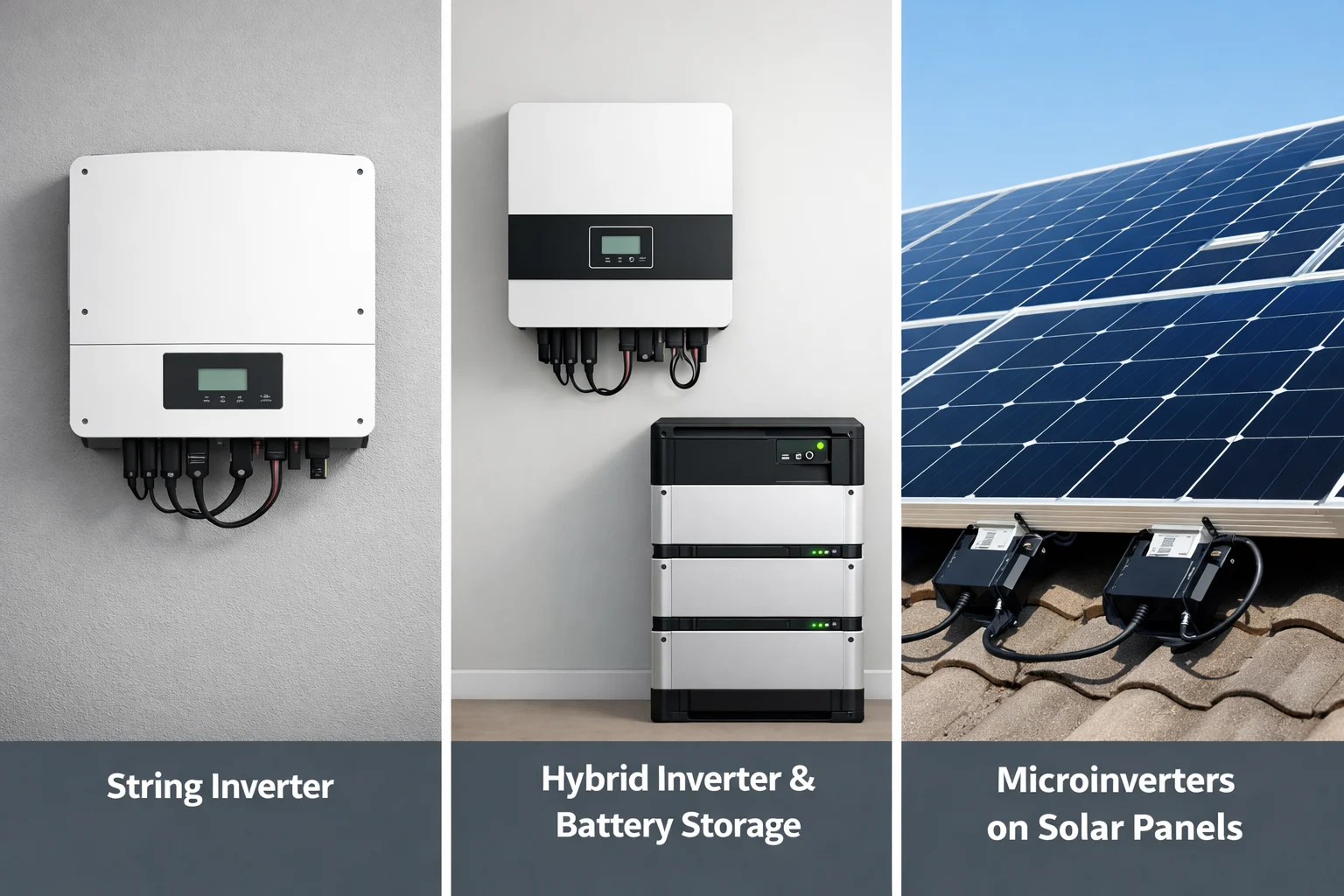
String Inverters: The Indian Standard
This is the most common type of inverter in India. All your solar panels are connected in a "string" (a series circuit) and feed into a single, central inverter.
How it works: Think of it like a string of Diwali lights. If one bulb goes out, the whole string dims. Similarly, if one panel gets shaded or dirty, the performance of the entire string drops to the level of the weakest panel.
Best for: Homes with simple rooftops, no shading issues, reliable grid power, and a focus on keeping costs low.
Hybrid Inverters: The Power Cut Solution
A hybrid inverter combines a solar inverter and a battery inverter in one unit. It can manage solar panels, the grid, and a battery bank simultaneously.
How it works: During the day, it powers your home with solar and charges the battery. If there's a power cut, it automatically switches to battery mode, keeping your lights and fans running. It can also store excess solar energy in the battery instead of exporting it to the grid.
Best for: Homes that experience frequent power cuts, or homeowners who want energy independence and backup power.
Microinverters: The New Age Technology
Instead of one central inverter, microinverters are small units installed on the back of each solar panel. Each panel operates independently.
How it works: Each panel has its own microinverter. If one panel is shaded, only that panel's output is affected. The rest continue generating at full capacity. This maximizes energy harvest, especially on complex roofs.
Best for: Homes with complex rooftops, multiple orientations, or significant shading from trees or neighboring buildings.
Head-to-Head Comparison: String vs Hybrid vs Micro (2026)
Here's how they stack up against each other on the factors that matter most to Indian homeowners.
1. Price Comparison (₹ Cost Breakdown)
Cost is often the deciding factor for Indian middle-class families. Prices are for the inverter component only (excluding panels and batteries).
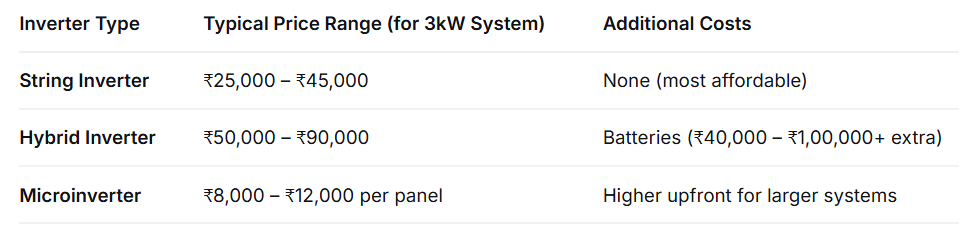
Verdict: String inverters are the most budget-friendly. Hybrids cost significantly more but include battery capability. Microinverters have the highest per-watt cost, making them the most expensive option for most Indian homes.
2. Efficiency and Performance
All modern inverters are highly efficient (95-98%), but the way they handle real-world conditions differs.
- String Inverter: High efficiency in ideal conditions. But a shaded panel reduces the entire string's output.
- Hybrid Inverter: Similar efficiency to string inverters but adds the benefit of storing excess power.
- Microinverter: Highest overall energy harvest in real-world conditions. Each panel operates at its maximum, independent of others.
Verdict: Microinverters win on real-world performance, especially on roofs with shading or multiple angles.
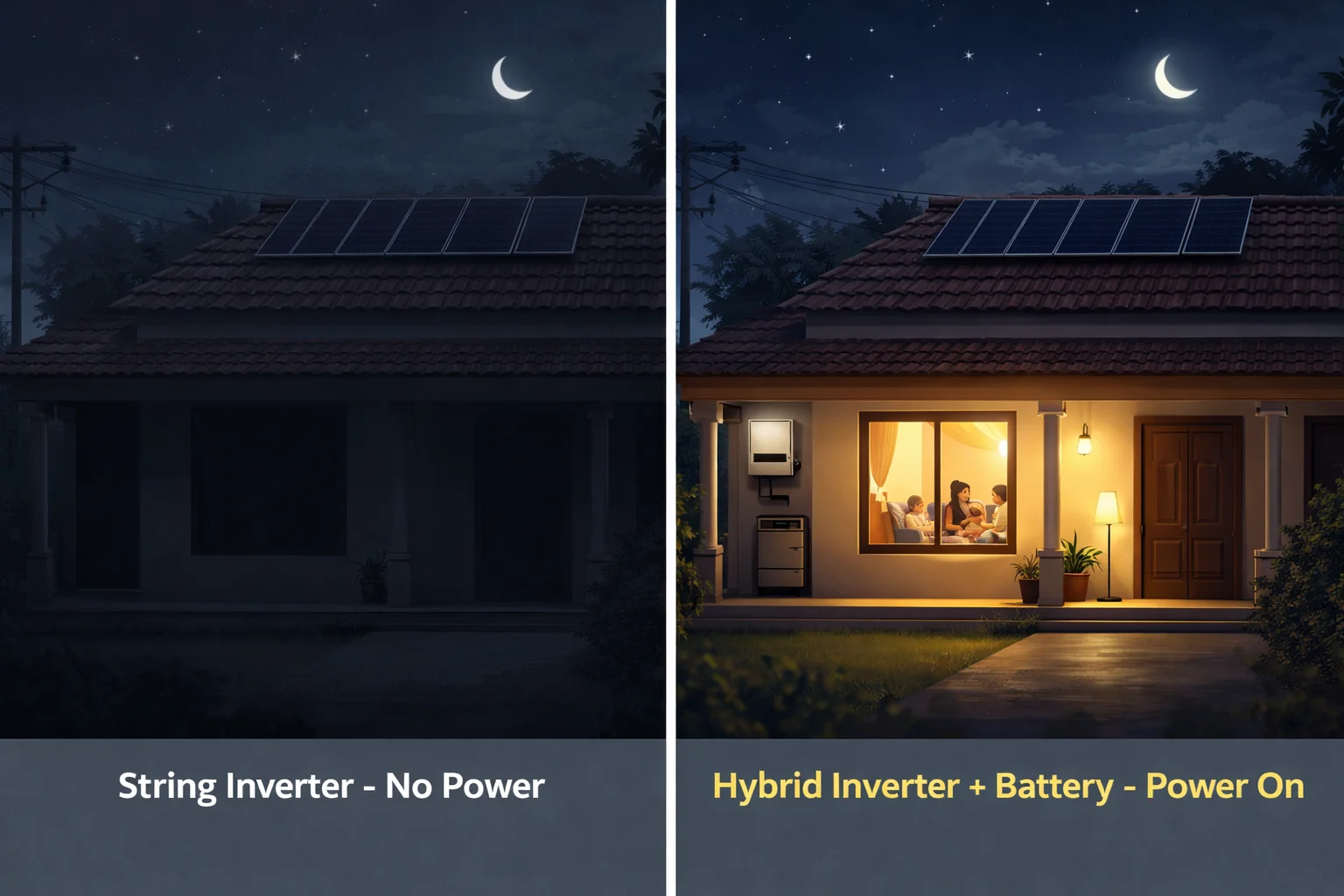
3. Power Cut Backup Capability
This is a critical differentiator for Indian homes where power cuts are still common.
- String Inverter: Zero backup. By law (and for safety), on-grid string inverters must shut down during a power cut. Your solar system will not work when the grid is down.
- Hybrid Inverter: Full backup. With a battery, you can power essential loads (lights, fans, refrigerator) during a power cut. Some advanced hybrids can even run your AC during the day without batteries.
- Microinverter: No backup (without additional equipment). Standard microinverter systems also shut down during grid outages unless paired with a specialized storage solution (which adds cost).
Verdict: If power cuts are a daily struggle, hybrid inverters with batteries are the clear winner.
4. Monitoring and Shading Performance
India's cities have tall buildings and trees that can cause partial shading.
- String Inverter: Basic monitoring at the system level. Shading on one panel affects the whole system.
- Hybrid Inverter: Similar to string inverters in terms of shading impact. Offers good monitoring features.
- Microinverter: Panel-level monitoring. You can see exactly how much each panel is generating. Shading on one panel does not affect the others.
Verdict: Microinverters offer superior monitoring and shade tolerance, making them ideal for complex rooftops.
5. Lifespan and Warranty
- String Inverter: Typically 5-10 years warranty. Often needs replacement once during the 25-year life of your panels. A replacement costs ₹25,000-40,000.
- Hybrid Inverter: 5-10 years warranty. Batteries last 5-10 years depending on usage and type (lead-acid vs lithium-ion).
- Microinverter: 20-25 years warranty, matching the lifespan of your solar panels. No mid-life replacement costs.
Verdict: Microinverters last the longest and come with warranties that match your panels. String and hybrid inverters may require a replacement after 8-10 years.
Which Inverter Should You Choose? A Simple Decision Guide
Here's a straightforward way to decide based on your situation:
Choose a String Inverter if:
- You have a simple, unshaded rooftop facing south.
- Your area has reliable 24/7 grid power with few power cuts.
- You want the lowest upfront cost and fastest payback period.
- You're comfortable with the system shutting down during the rare power cut.
Choose a Hybrid Inverter if:
- You experience frequent power cuts and need backup power.
- You want to maximize self-consumption and store excess solar energy.
- You're planning to add electric vehicles or increase your power backup in the future.
- You're willing to invest more upfront for energy independence.
Choose a Microinverter if:
- Your roof has shading issues from trees, buildings, or has multiple orientations.
- You want panel-level monitoring and maximum energy harvest.
- You plan to keep your system for 20+ years without replacing the inverter.
- You're willing to pay a premium for the best technology and performance.
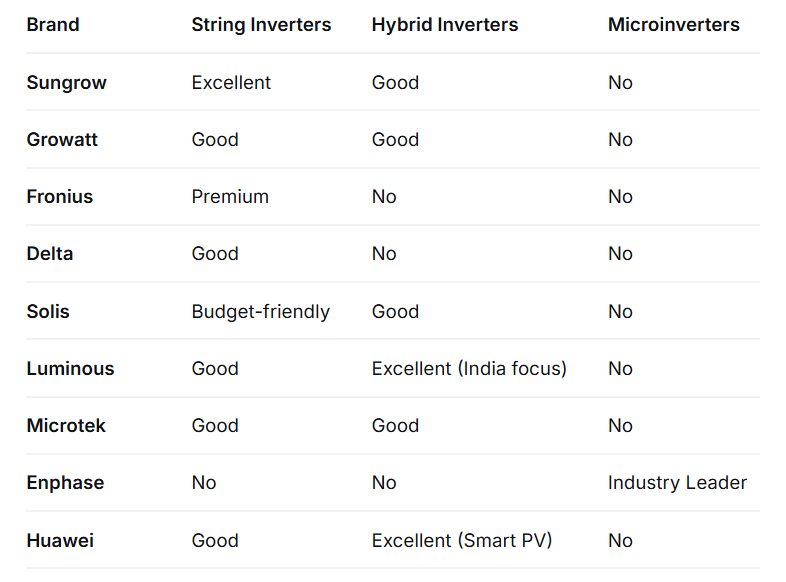
Top Solar Inverter Brands in India for 2026
When choosing an inverter, stick with reputable brands that have a service network in your city.
The PM Surya Ghar Subsidy and Your Inverter Choice
Under the PM Surya Ghar: Muft Bijli Yojana, the subsidy of up to ₹78,000 is provided for the complete solar system (panels, inverter, and installation). The subsidy amount does not change based on your inverter choice.
However, here's what you need to know:
- String Inverter: Fully eligible for subsidy. Lowest net cost after subsidy.
- Hybrid Inverter: Eligible for subsidy. But you'll pay extra for batteries, which are not covered by the central subsidy. Some state schemes may offer additional support for batteries.
- Microinverter: Eligible for subsidy if the complete system meets MNRE guidelines. However, the higher upfront cost may reduce the effective subsidy benefit.
Pro Tip: Apply for the PM Surya Ghar subsidy through the official portal before installation. Your inverter choice must be from an MNRE-approved manufacturer to qualify.
Conclusion: Making the Right Choice for Your Home
Choosing the right inverter is just as important as choosing your solar panels. Your decision should be based on your budget, your power cut situation, and your roof's characteristics.
- For most Indian homes with reliable power and simple roofs, a string inverter offers the best value and fastest ROI.
- If power cuts are a daily headache, a hybrid inverter with batteries is worth the extra investment for peace of mind.
- If you have a complex roof with shading and want the best technology, microinverters deliver superior performance and longevity.
Before making a decision, get quotes from 2-3 local installers. Ask them about warranty, service response times in your city, and whether the inverter is ALMM-compliant (for the panels) and meets DISCOM requirements for net metering. Your perfect solar journey starts with the right inverter.


