

You walk into a solar installer's office in Delhi, Mumbai, or Bengaluru. The salesperson pulls out three brochures. "We have monocrystalline panels—the premium choice. Or polycrystalline if you're budget-conscious. And our latest: bifacial panels that generate power from both sides!"
You nod politely, but internally you're thinking: What's the actual difference? Which technology makes sense for an Indian rooftop? Is paying ₹15 more per watt for "bifacial" worth it, or is it marketing hype?
For Indian homeowners in 2026, this isn't just a technical question—it's a financial one. The wrong panel choice could mean losing 15–20% efficiency in summer heat, paying ₹40,000 extra for unnecessary technology, or missing out on better ROI over 25 years.
This complete technology comparison explains monocrystalline vs polycrystalline vs bifacial solar panels in plain language. You'll learn how each type works, efficiency ratings (19–23%), pricing in India (₹60–₹90 per watt as of Feb 2026), performance in Indian climate (heat, dust, monsoon), ALMM compliance status, and most importantly—which panel type matches your roof, budget, and energy needs. By the end, you'll walk into that solar shop armed with the right questions.
UNDERSTANDING THE THREE PANEL TECHNOLOGIES
What Is a Monocrystalline Solar Panel?
Monocrystalline panels are made from single-crystal silicon. Manufacturers grow a cylindrical silicon ingot using the Czochralski process, then slice it into thin wafers. Because the silicon structure is uniform (one continuous crystal), electrons move freely with minimal resistance, producing higher efficiency.
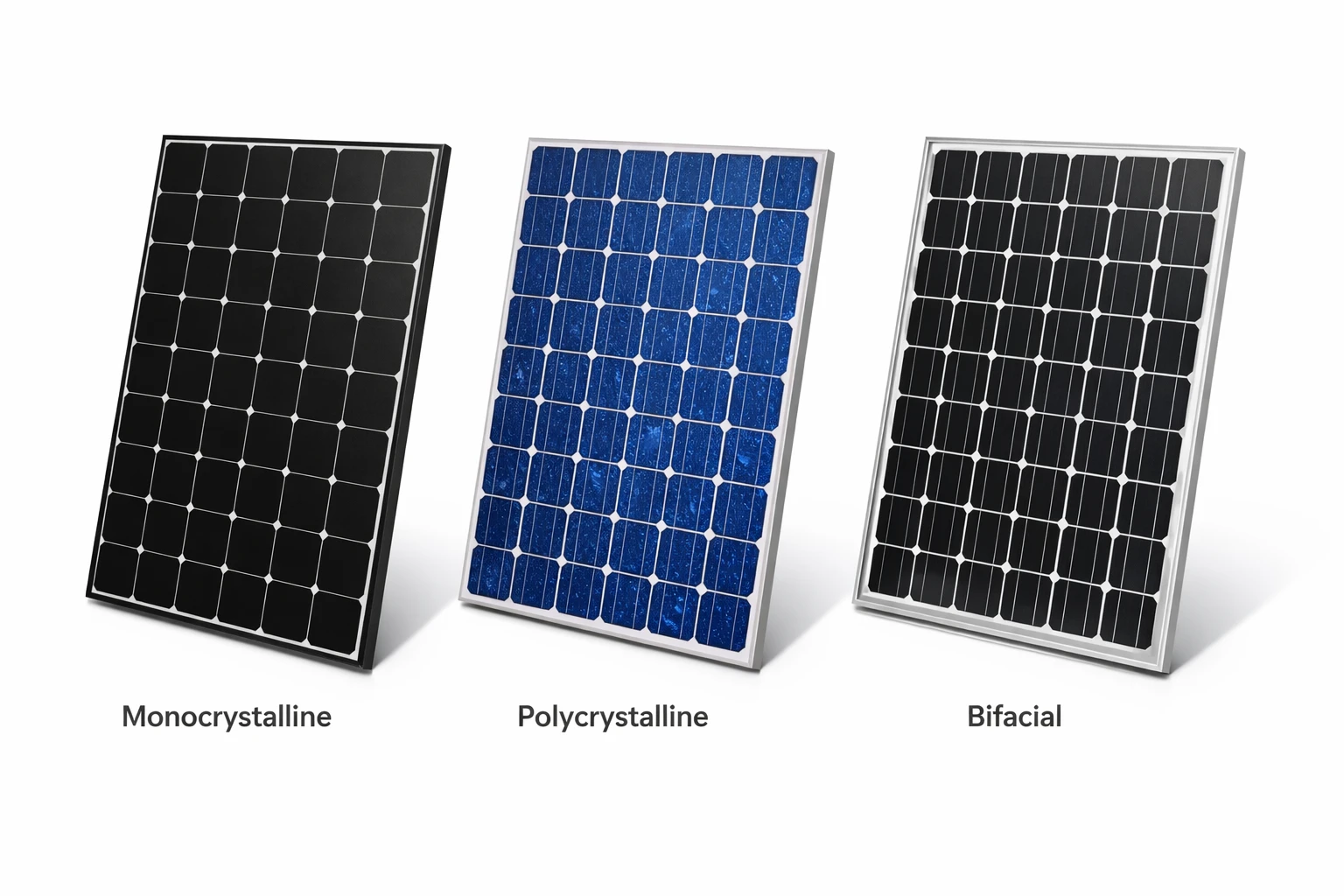
Visual identification: Sleek black color with rounded or clipped corners on cells (due to cylindrical ingot shape). Premium aesthetic that homeowners in tier 1 cities prefer.
How they're made: Pure silicon heated to 1400°C → Single crystal ingot grown → Sliced into wafers → Doped with chemicals → Anti-reflective coating → Assembled into panels.
Efficiency range in India 2026: Standard Mono PERC panels achieve 19–21% efficiency. Advanced Mono PERC Half-Cut panels reach 21.5–22.5% efficiency. Premium TOPCon monocrystalline panels deliver 22–23% efficiency.
Lifespan: 25–30 years with degradation rate of approximately 0.5% per year. After 25 years, a good monocrystalline panel still operates at 87–90% of original capacity.
What Is a Polycrystalline Solar Panel?
Polycrystalline panels are made from multiple silicon fragments melted together. Manufacturers pour molten silicon into square molds, cool it, then slice into wafers. The multi-crystal structure creates grain boundaries that restrict electron movement, reducing efficiency compared to monocrystalline.
Visual identification: Blue color with square-cut cells (no rounded edges). Visible fragmented crystal pattern on surface.
How they're made: Silicon fragments melted in crucible → Poured into square mold → Cooled to form block → Sliced into square wafers → Processed into cells → Assembled.
Efficiency range in India 2026: Polycrystalline panels typically achieve 15–17% efficiency. The best polycrystalline models reach 17.5% maximum.
Lifespan: 20–25 years with degradation rate of approximately 0.8% per year under harsh Indian conditions. After 25 years, output drops to 80–83% of original.
The 2026 Reality: Polycrystalline Is Nearly Obsolete in India
Here's what solar installers won't tell you upfront: Polycrystalline panel production in India has largely stopped as of 2024–2026. Major manufacturers (Waaree, Tata, Adani, Vikram Solar, Loom Solar) have discontinued polycrystalline lines entirely, focusing only on monocrystalline Mono PERC and TOPCon technology.
Why? Polycrystalline panels have lower efficiency (15–17% vs 19–23% mono), faster degradation, higher temperature coefficient (perform worse in heat), and declining cost advantage. In 2020, polycrystalline panels cost ₹10–15/watt less than monocrystalline. By 2026, the price gap has shrunk to just ₹3–5/watt—not worth the performance sacrifice.
If an installer offers you polycrystalline panels in 2026, they're either: Clearing old inventory from 2022–2023 stock, or Sourcing cheap imported panels (likely non-ALMM, disqualifying you from PM Surya Ghar subsidy). Avoid polycrystalline. Choose monocrystalline or bifacial instead.
What Are Bifacial Solar Panels?
Bifacial panels capture sunlight from BOTH the front and rear surfaces. Traditional panels (mono and poly) are monofacial—only the front generates power. Bifacial panels have transparent back sheets or dual glass construction, allowing reflected/diffused light from the ground or surrounding surfaces to hit the rear side and generate additional electricity.
How they work: Front side captures direct sunlight (like any panel). Rear side captures reflected light bouncing off ground, rooftop surface, or nearby buildings—called "albedo gain." Total output can be 8–30% higher than monofacial panels in optimal conditions.
Technology used: Most Indian bifacial panels in 2026 use N-Type TOPCon cells (Tunnel Oxide Passivated Contact) for maximum efficiency. Some use Mono PERC Half-Cut bifacial cells.
Visual identification: Transparent or glass backsheet (you can see through the panel). Often dual-glass construction for durability. Sleek, futuristic appearance.
Efficiency range in India 2026: Front-side efficiency: 21–23.7% (among the highest available). Total system gain including rear side: 10–30% additional output depending on installation conditions.
Lifespan: 25–30 years with degradation rate as low as 0.3–0.4% per year (better than standard monocrystalline). TOPCon bifacial panels maintain 90%+ capacity after 25 years.
PRICING COMPARISON: WHAT YOU'LL ACTUALLY PAY IN INDIA 2026
Let me give you honest, real-world pricing from tier 1 city installers (Mumbai, Delhi, Bengaluru, Chennai, Pune, Ahmedabad) as of February 2026:
Monocrystalline (Mono PERC) Panels: Price per watt: ₹65–₹78. For 3 kW system (panels only): ₹1,95,000–₹2,34,000. Brands in this range: Vikram Solar, Goldi Solar, Premier Energies, Emmvee (budget), Waaree Energies, RenewSys (mid-range), Tata Power Solar, Adani Solar (premium).
Monocrystalline TOPCon (Advanced Mono): Price per watt: ₹75–₹90. For 3 kW system (panels only): ₹2,25,000–₹2,70,000. Brands: Adani Solar TOPCon, Waar ee TOPCon, Gautam Solar TOPCon. Higher upfront cost but 1–2% better efficiency and lower degradation.
Bifacial (Mono PERC Bifacial or TOPCon Bifacial): Price per watt: ₹75–₹90 (10–15% premium over standard mono). For 3 kW system (panels only): ₹2,25,000–₹2,70,000. Brands: Waaree Bifacial, Adani Bifacial TOPCon, Avaada Electro TOPCon Bifacial, Renew Sys Bifacial, INA Solar Bifacial.
Polycrystalline (If You Find Old Stock): Price per watt: ₹60–₹70. For 3 kW system: ₹1,80,000–₹2,10,000. Recommendation: Skip. Not worth saving ₹15,000–₹24,000 to lose 15–20% performance and subsidy eligibility risk.
Value for Money Analysis:
Standard Mono PERC (₹65–₹78/watt) offers the best balance of efficiency, pricing, and ALMM availability for most Indian homes. This is the sweet spot for 1–5 kW residential systems.
Bifacial panels (₹75–₹90/watt) make financial sense ONLY if you have high-reflectivity rooftop conditions—white-painted RCC roofs, light-colored tiles, or installations with 1.5+ feet clearance allowing rear-side light. If your roof is dark-colored, dirty, or panels sit flat with no gap, you pay 15% more for 5–8% gain—poor ROI.
TOPCon monocrystalline (₹75–₹90/watt) is worth the premium for large systems (5–10 kW+) where the 1–2% efficiency gain and lower degradation compound significantly over 25 years. For small 1–3 kW systems, stick with standard Mono PERC.


