

You are sitting at your dining table in Mumbai or Bengaluru, spreadsheet open, calculator in hand. A professional solar installer has quoted ₹2,10,000 for a 3 kW rooftop system. You have been watching YouTube videos on solar installation for a week now. The panels cost ₹66,000 online. The inverter is ₹24,000. Mounting structure ₹12,000. Some wiring, MCBs, earthing—maybe another ₹15,000. That is ₹1,17,000 in materials. The installer is charging ₹93,000 for labor and 'other services.' Can you really not do this yourself and pocket that ₹93,000?
This is the exact question thousands of Indian homeowners in tier 1 cities ask themselves in 2026. DIY solar installation seems tempting—especially when professional installers charge what feels like a premium. But here is the reality check no YouTube video will tell you: In India, DIY solar installation for PM Surya Ghar subsidy-eligible systems is not just difficult—it is practically impossible without forfeiting the ₹78,000 government subsidy, failing DISCOM net metering approval, voiding your panel warranty, and potentially creating life-threatening safety hazards.
This brutally honest 2026 comparison breaks down DIY solar installation vs professional installation in India with actual costs, hidden expenses, legal barriers, subsidy implications, DISCOM requirements, and safety risks. By the end, you will understand why 98% of successful solar installations in tier 1 Indian cities use professional installers—and the 2% that do DIY regret it within six months.
The DIY Solar Installation Fantasy vs Indian Reality
Let us start with what DIY solar installation means in the Indian context. In Western countries like the USA or Australia, DIY solar kits are common, grid connection rules are simpler, and homeowner liability insurance is standard. India is fundamentally different.
What DIY Solar Actually Involves (Not What YouTube Shows You)
Here is the complete DIY solar installation process in India:
1. Purchase ALMM-compliant panels (₹66,000–₹84,000 for 3 kW), BIS-certified inverter (₹24,000–₹36,000), galvanized mounting structure (₹10,500–₹13,500), DC/AC cables, MCBs, earthing materials, lightning arrestor—total materials ₹1,15,000–₹1,50,000.
2. Transport all materials to your rooftop. Panels weigh 18–25 kg each. You need 10 panels for 3 kW. That is 180–250 kg total just for panels, plus 25 kg inverter, 60 kg mounting structure. No elevator? Good luck carrying this up four flights of stairs.
3. Conduct structural load assessment. Hire a structural engineer (₹3,000–₹5,000) to confirm your RCC roof can handle 600–750 kg. Skip this? Risk slab cracking mid-monsoon—repair costs ₹2.5 lakh (real case from Surat 2020).
4. Waterproof your roof. Apply polymer coating (₹50–₹80 per sq ft) before mounting installation. Wait 48–72 hours for curing. Most DIYers skip this—hello leakage during July rains.
5. Install mounting structure. Drill 40–60 anchor bolt holes into RCC slab using rotary hammer drill (rent ₹500/day if you do not own one). Chemical anchor each bolt. Seal with polyurethane. Or use ballasted (non-penetrating) system—add 10–15 kg/m² load, confirm roof can handle it.
6. Mount panels. Work at 10–20 feet height. Indian residential buildings have parapets 3–4 feet high—fall protection needed. Panels are slippery when sweaty. One slip = hospital or worse.
7. Wire DC circuits. Solar panels generate 40–50V DC even in cloudy conditions. Touch wrong wires = electric shock. Connect panels in series/parallel configuration per system design. One wrong polarity connection = inverter damage (₹24,000 replacement).
8. Install inverter indoors (not in direct sun—reduces lifespan). Wire AC output to your distribution board. This requires opening your electrical panel—high risk without training.
9. Install earthing system. Dig earth pit, install GI strip and electrode, ensure <5 ohms resistance. Lightning arrestor if in high-lightning zone. Miss this = equipment damage during thunderstorms.
10. Apply for DISCOM net metering approval. Submit technical drawings, single-line diagrams, inverter specs, panel datasheets. DISCOM schedules site inspection. If they find non-compliant work (which DIY installations almost always have), they reject approval. No net metering = can't export excess power = ROI destroyed.
11. Wait for DISCOM to install bidirectional meter (15–45 days depending on state). Then commissioning inspection. If DISCOM inspector finds safety issues, they red-flag your installation. Costly rework required.
12. Apply for PM Surya Ghar subsidy on pmsuryaghar.gov.in. Here is where DIY hits a brick wall: Subsidy requires installation by MNRE-empanelled/DISCOM-registered vendor. DIY installation? Automatically disqualified. You forfeit ₹78,000 subsidy.
Total DIY time commitment: 15–30 days for a first-timer (professionals do it in 3–5 days). Total DIY skill requirements: Electrical engineering basics, construction safety training, tool handling expertise, local DISCOM regulation knowledge, MNRE technical specification understanding.
🚨 Reality Check:
A civil engineer from Pune attempted DIY solar installation in 2024. He saved ₹60,000 in labor but: (1) His non-ALMM panels disqualified him from subsidy—lost ₹78,000. (2) BESCOM rejected his net metering application three times due to improper earthing—6-month delay. (3) Roof started leaking after first monsoon—₹35,000 waterproofing repair. (4) Inverter failed in Year 2 because warranty was void (non-certified installation). Net loss: ₹1,49,000 compared to hiring a professional.
What Professional Solar Installation Actually Includes (The ₹93,000 Question)
When you hire a DISCOM-empanelled professional installer for ₹2,10,000 (3 kW system in tier 1 cities like Mumbai, Delhi, Bengaluru, Chennai as of Feb 2026), here is what that ₹93,000 'labor charge' actually covers:
Pre-Installation Services (Worth ₹15,000–₹25,000)
• Structural engineer assessment and certification for load-bearing capacity—protects you legally if anything goes wrong.
• Shadow analysis using specialized software—identifies optimal panel placement to maximize generation by 15–20% vs DIY guesswork.
• System design with exact panel configuration, tilt angle calculation (latitude-specific for Indian cities), and electrical schematic drawing.
• DISCOM coordination—they handle all applications, technical feasibility submissions, and follow-ups on your behalf.
• Subsidy application on PM Surya Ghar portal using your Aadhaar, bank details, electricity bill—they know the exact documentation needed.
Installation Labor & Safety (Worth ₹30,000–₹45,000)
• Certified electricians and roofers with 5+ years solar experience—not your brother-in-law who 'knows wiring.'
• Safety equipment: harnesses for workers on high roofs, hard hats, cut-resistant gloves, safety goggles, first-aid kit on-site.
• Professional tools: calibrated torque wrenches (prevents over-tightening that cracks panels), insulated electrical tools rated for 1000V DC, laser levels for perfect panel alignment, thermal imaging cameras to detect hot spots.
• Insurance coverage—if a worker falls or equipment damages your property, their company insurance covers it. Your DIY injury? Your medical bills.
• 3–5 day installation (vs your 15–30 days) because they work efficiently in teams, no trial-and-error.
Materials Markup & Quality Assurance (Worth ₹10,000–₹18,000)
• Bulk purchasing power—professionals buy ALMM panels at ₹58–₹62/watt, not retail ₹68–₹78/watt. They mark up to ₹70–₹75/watt but still source better quality.
• Warranty registration—they register panel, inverter, and system warranties properly on manufacturer portals. DIY? You probably skipped this step and your 25-year warranty is actually void.
• Quality control—professionals reject B-grade panels, test every panel voltage before mounting, verify inverter calibration. You? You trust the seller sent good stock.
Post-Installation Services (Worth ₹20,000–₹30,000)
• Net metering application, DISCOM coordination, meter installation follow-up—they know exactly whom to call when your application sits idle for 40 days.
• Commissioning inspection prep—they ensure everything passes DISCOM inspection on first attempt. DIY fails? Rework costs ₹15,000–₹40,000.
• System commissioning and testing—voltage checks, current measurements, grid synchronization, monitoring app setup, homeowner training.
• Subsidy claim submission with correct documentation—including photos at specific angles DISCOMs require, installer certification, commissioning reports. DIY this? High rejection rate.
• 1-year free service visits (most companies)—panel cleaning, inverter checks, performance optimization. DIY? You climb the roof yourself with a bucket and mop.
• 25-year performance support—when your inverter fails in Year 8, professional installers help you claim warranty. DIY? Good luck navigating Waaree's customer service portal yourself.
💡 The Hidden Value:
That ₹93,000 is not just 'labor.' It is insurance against ₹78,000 subsidy loss, ₹35,000–₹2,50,000 roof damage, ₹24,000 inverter replacement from improper installation, 6-month net metering delays, warranty voidance, and potential injury/death. Professional installation in India is not a luxury—it is a legal and financial necessity.
Real Cost Comparison: DIY vs Professional (3 kW System, Tier 1 Cities, 2026)
Let us break down actual costs honestly, including hidden expenses:
DIY Solar Installation Costs (All-In)
Materials (purchased retail, not bulk):
• Solar panels (ALMM-compliant, 3 kW): ₹66,000–₹84,000
• Solar inverter (BIS-certified, 3 kW): ₹24,000–₹36,000
• Mounting structure (galvanized): ₹10,500–₹18,000 (higher if ballasted)
• DC/AC cables, MCBs, junction boxes: ₹8,000–₹12,000
• Earthing materials, lightning arrestor: ₹4,000–₹6,000
• Waterproofing (if done): ₹15,000–₹24,000
• SUBTOTAL MATERIALS: ₹1,27,500–₹1,80,000
Tools & Equipment Rental/Purchase:
• Rotary hammer drill (rent 5 days): ₹2,500 or buy ₹8,000
• Multimeter, clamp meter, insulation tester: ₹5,000–₹8,000
• Safety harness, helmet, gloves: ₹3,000–₹5,000
• Ladders, scaffolding (rent): ₹2,000–₹4,000
• SUBTOTAL TOOLS: ₹12,500–₹25,000
Professional Services You Still Need:
• Structural engineer assessment: ₹3,000–₹5,000
• Electrician for AC board work (if you are not confident): ₹5,000–₹10,000
• DISCOM application fees, meter charges: ₹5,000–₹12,000
• SUBTOTAL SERVICES: ₹13,000–₹27,000
TOTAL DIY COST (before subsidy): ₹1,53,000–₹2,32,000
MINUS PM Surya Ghar Subsidy: ₹0 (disqualified—DIY not eligible)
NET DIY COST: ₹1,53,000–₹2,32,000
Hidden Costs You Will Discover Later:
• Roof leakage repair (80% probability if waterproofing skipped): ₹25,000–₹80,000
• Inverter replacement (warranty void): ₹24,000–₹36,000 in Year 2-5
• Net metering rejection rework: ₹15,000–₹40,000
• Medical bills if injury occurs: ₹50,000–₹5,00,000 (or worse)
• POTENTIAL TOTAL: ₹2,67,000–₹8,88,000 (worst case)
Professional Installation Costs
Tier 1 City Professional Quote (2026):
• Total system cost (3 kW, all-inclusive): ₹1,90,000–₹2,35,000
• Mumbai/Delhi: ₹2,10,000–₹2,35,000 (higher labor, permits)
• Bengaluru/Chennai: ₹1,90,000–₹2,15,000
• Pune/Ahmedabad: ₹1,85,000–₹2,10,000
MINUS PM Surya Ghar Subsidy: ₹78,000 (eligible with professional installer)
NET PROFESSIONAL COST: ₹1,12,000–₹1,57,000
What You Get:
• Valid manufacturer warranties (25 years panels, 5–10 years inverter)
• DISCOM-approved net metering (starts earning from Day 1)
• Legal compliance (no liability if something goes wrong)
• Insurance coverage during installation
• 1-year free service + lifetime support for warranty claims
• Peace of mind (zero risk of ₹2.5 lakh roof damage or personal injury)
🎯 The Verdict:
Professional installation in India COSTS LESS than DIY when you factor in subsidy loss. DIY net cost: ₹1,53,000–₹2,32,000. Professional net cost: ₹1,12,000–₹1,57,000. You save ₹41,000–₹75,000 by hiring professionals. Plus you avoid all hidden disaster costs.
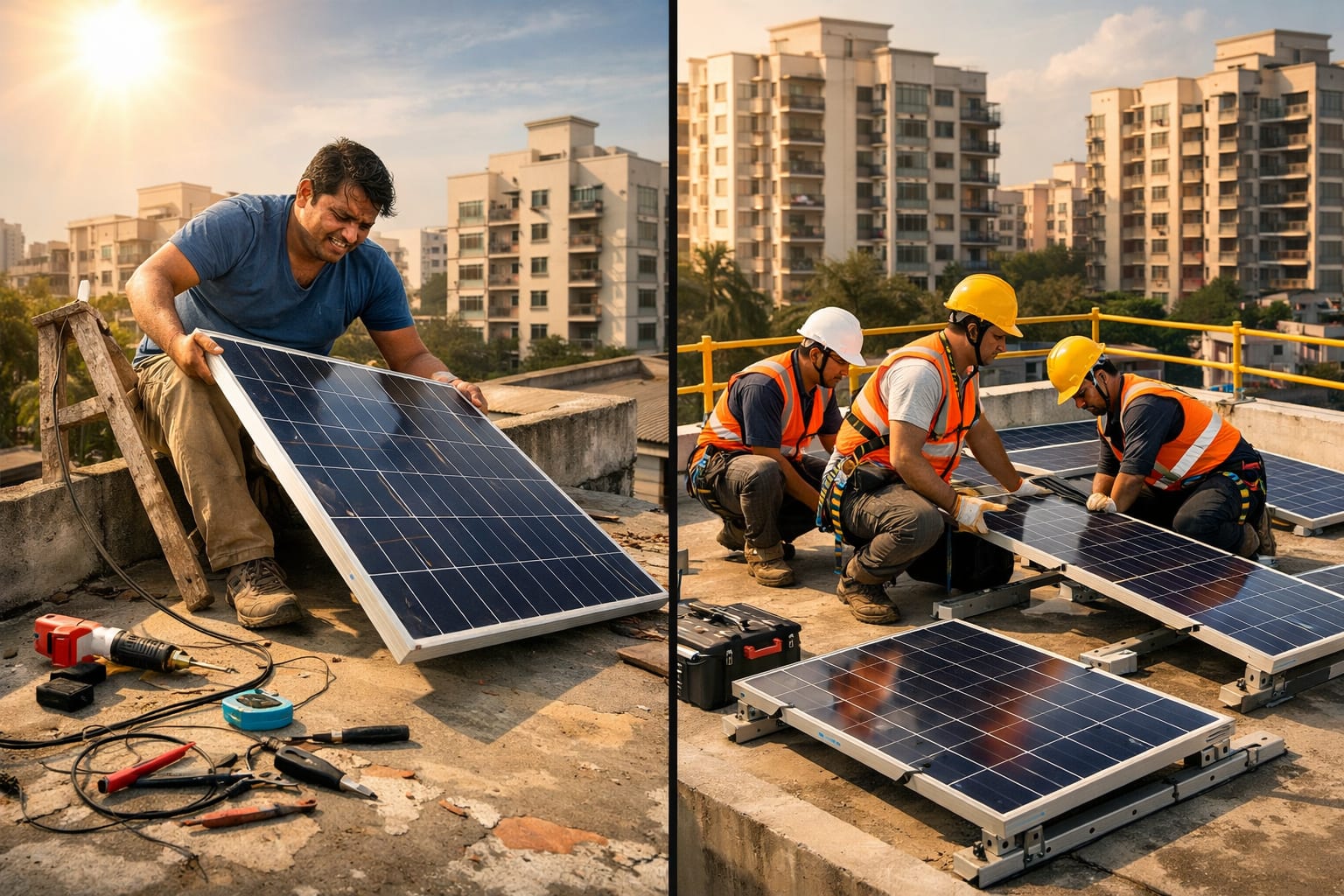
Why DIY Solar Kills Your PM Surya Ghar Subsidy (The ₹78,000 Dealbreaker)
This is the single biggest reason DIY solar installation is impractical in India 2026. The PM Surya Ghar Muft Bijli Yojana subsidy—up to ₹78,000 for a 3 kW system—is ONLY available if you use a DISCOM-empanelled or MNRE-approved vendor.
The Official Requirements (From pmsuryaghar.gov.in)
13. Register on the PM Surya Ghar national portal with your state, DISCOM, mobile number, and consumer account ID.
14. Select a vendor from the DISCOM-empanelled vendor list on the portal. This is MANDATORY. The portal will not let you proceed without choosing a registered vendor.
15. The selected vendor conducts installation, submits technical documentation, and uploads photos to the portal.
16. DISCOM inspects the installation and issues a commissioning certificate ONLY if installed by an approved vendor.
17. After commissioning approval, subsidy is credited via Direct Benefit Transfer to your Aadhaar-linked bank account.
⛔ The DIY Trap:
If you install the system yourself or use a non-empanelled installer (your electrician friend, a cheaper local contractor), your application will be REJECTED at Step 2. The portal requires vendor selection from the approved list. There is no 'DIY' or 'self-installed' option. Zero flexibility. Zero exceptions.
Can you register yourself as a vendor?
No. MNRE vendor empanelment requires: (1) GST registration as a solar EPC company, (2) ₹10–50 lakh annual turnover proof, (3) Installation track record of 50+ kW minimum, (4) BIS/NABL certifications, (5) ₹1–5 lakh empanelment fees depending on state. Individual homeowners cannot qualify.
Can you claim subsidy after DIY installation?
No. The commissioning certificate (required for subsidy disbursement) is issued by DISCOM only after verifying the vendor credentials and installation quality. Self-installed systems will not pass this verification. DISCOMs explicitly reject DIY installations for subsidy claims.
DISCOM Net Metering Approval: The DIY Nightmare
Even if you are okay forfeiting the ₹78,000 subsidy (which would be financially insane), you still need DISCOM approval for net metering. Without net metering, your solar system can only power your home during daytime—no export credits, no grid backup at night, ROI destroyed.
Why DISCOMs Reject DIY Solar Net Metering Applications
DISCOM technical inspectors check for:
• Proper earthing (resistance <5 ohms, tested with calibrated megger)—90% of DIY installs fail this.
• Lightning protection if building >15m height—DIYers often skip lightning arrestors.
• Correct inverter settings (anti-islanding protection, voltage/frequency limits per state regulations)—requires specialized knowledge.
• ALMM-compliant panels with datasheets and BIS certification proof—DIYers buying from grey markets lack these documents.
• Professional installation certificate from a licensed electrician—DIY by definition has no certificate.
• Structural safety clearance especially for rooftop load—your self-assessment does not count, DISCOMs want engineer stamps.
Real case from Delhi 2024: A software engineer DIY-installed 2 kW solar. BSES Yamuna rejected his net metering application four times over 8 months for: (1) Improper earthing, (2) Missing anti-islanding inverter settings documentation, (3) No structural engineer certificate. He finally hired a professional to 'certify' his work—cost ₹45,000. He could have just used a professional installer from the start and saved 8 months of headache.
Safety Risks: Why DIY Solar Can Kill You (Literally)
This is not YouTube where everyone survives and gets monetized. Solar installation in India involves three deadly hazards:
1. Working at Height (Fall Risk)
Indian residential rooftops are typically 10–40 feet high. Tier 1 city apartment buildings can be 30–100 feet. Rooftops have smooth surfaces, no railings on many older buildings, and parapets only 3–4 feet high. Statistics from OSHA-equivalent Indian safety studies: 30% of construction injuries are fall-related. 18% of fatal workplace accidents in India are falls from height. Professional installers use harnesses, anchor points, safety observers. You? Standing on a wobbly ladder borrowed from your building watchman.
2. Electrical Shock (DC Voltage Risk)
Solar panels generate 40–50V DC even in cloudy conditions. A 3 kW system has 300–400V DC in series configuration. DC shocks are MORE dangerous than AC because they cause muscle contraction—you cannot let go. Touch wrong wires while sweaty (you will be—it is 40°C on Indian rooftops in summer) = cardiac arrest. Professional electricians use insulated tools rated 1000V DC, work with buddy system, cover panels during wiring. DIYers? Touching live wires with bare hands because they 'turned off the inverter' (panels still generate voltage!).
3. Structural Damage & Monsoon Failures
Improper anchor bolt installation or ballast load miscalculation can crack RCC slabs. Concrete cracking is progressive—small crack in May becomes massive water ingress in July monsoon. Repair costs ₹1.5–2.5 lakh if internal steel reinforcement is exposed to water and rusts. In extreme cases, slab collapse risk (rare but has happened—Ahmedabad 2020, 5 kW system caused corner slab failure, ₹8 lakh repair). Professional installers carry ₹25 lakh–₹1 crore public liability insurance. Your DIY project? Your liability, your legal battle if someone gets hurt.
When (If Ever) Does DIY Solar Make Sense in India?
Brutal honesty: For grid-connected systems eligible for PM Surya Ghar subsidy, DIY makes sense in ZERO cases. But there are narrow scenarios where partial DIY might work:
Scenario 1: Off-Grid Systems in Remote Areas (No Subsidy, No Net Metering)
If you live in a remote farmhouse with no reliable grid connection and are installing an off-grid system with battery backup—no subsidy eligibility, no DISCOM approval needed—DIY becomes theoretically possible. But even then, you need: (1) Electrical engineering knowledge to size batteries and configure charge controllers, (2) Waterproofing and structural skills, (3) Safety equipment. ROI comparison: Professional off-grid installation for 3 kW with 10 kWh battery costs ₹3.5–4.5 lakh. DIY might save ₹60,000–₹1,00,000 in labor. But if you screw up battery wiring, lithium battery fire risk (₹1.5 lakh battery replacement + potential home fire damage).
Scenario 2: Hybrid Approach (Professional for Critical, DIY for Accessories)
Hire professional DISCOM-empanelled installer for core system (panels, inverter, mounting, wiring, net metering approval, subsidy claim). This ensures eligibility for ₹78,000 subsidy and DISCOM approval. Then DIY the optional extras: panel cleaning system (₹2,000–₹5,000), monitoring hardware upgrades (₹3,000–₹8,000), aesthetic panel framing or cable management (₹2,000–₹5,000). Savings: ₹7,000–₹18,000 without risking core system or subsidy.
Scenario 3: Renovation/Expansion with Existing Professional System
You have a professionally installed 3 kW system from 2021. Now you want to add 2 kW more capacity in 2026. Your original installer is no longer available or quoting too high. You could DIY the expansion IF: (1) You hire a certified electrician to handle AC wiring and DISCOM approvals, (2) You buy ALMM-compliant panels with proper documentation, (3) You understand your original system configuration thoroughly. Risk: DISCOM may reject expansion if not done to their standards. Better: Get 2-3 quotes from current empanelled installers, negotiate.
🎯 Bottom Line:
If you are a tier 1 city homeowner installing a residential rooftop system in 2026 and want PM Surya Ghar subsidy + net metering (which 99% of people do), DIY is NOT an option. Period.
Conclusion: Why 98% of Indian Solar Buyers Choose Professional Installation
The YouTube DIY solar fantasy crashes into Indian legal and financial reality. Here is the final cost comparison that matters:
DIY Installation (3 kW system):
Materials: ₹1,27,500–₹1,80,000. Tools & services: ₹25,500–₹52,000. Subsidy: ₹0. Net cost: ₹1,53,000–₹2,32,000. Plus risk of: ₹78,000 subsidy loss (certain), ₹25,000–₹80,000 roof damage (80% probability), ₹24,000–₹36,000 warranty void (60% probability), ₹50,000–₹5,00,000 injury medical costs (5% probability but catastrophic), 6–12 month net metering delays (90% probability). Real total cost including risks: ₹2,67,000–₹8,88,000.
Professional Installation (3 kW system):
Total system: ₹1,90,000–₹2,35,000. Subsidy: ₹78,000 (guaranteed). Net cost: ₹1,12,000–₹1,57,000. Plus benefits of: Valid 25-year warranty, DISCOM net metering approval (starts Day 1), Legal compliance and insurance coverage, Zero injury risk (professional liability), 1-year service + lifetime support. Real total cost: ₹1,12,000–₹1,57,000 (no hidden costs).
Professionals cost ₹41,000–₹75,000 LESS than DIY when you factor in subsidy. Plus you eliminate all disaster risks. The question is not 'Can I DIY solar?' but 'Why would anyone DIY solar in India when professionals are cheaper and safer?'
Final advice for tier 1 city homeowners in Mumbai, Delhi, Bengaluru, Chennai, Kolkata, Hyderabad, Pune, Ahmedabad: Get 3 quotes from DISCOM-empanelled installers. Compare their pricing, warranty terms, and service reputation. Choose the best value professional—not the cheapest DIY disaster. Your solar system will outlast your car, your phone, and probably your next two laptops. Invest in professional installation. Your future self (and your bank account) will thank you.
Frequently Asked Questions (FAQ Schema)
Q: Can I install solar panels myself in India and still get the PM Surya Ghar subsidy?
A: No. The PM Surya Ghar Muft Bijli Yojana subsidy (up to ₹78,000 for 3 kW) is available ONLY if you use a DISCOM-empanelled or MNRE-approved vendor for installation. The portal requires mandatory vendor selection from an approved list—there is no DIY or self-installation option. If you install the system yourself or use a non-empanelled installer, you are automatically disqualified from subsidy and forfeit ₹30,000–₹78,000. Additionally, DISCOMs will reject net metering applications for DIY installations, making your system financially unviable.
Q: How much does professional solar panel installation cost in tier 1 Indian cities in 2026?
A: Professional installation costs vary by city and system size. For a 3 kW residential system in 2026: Mumbai/Delhi ₹2,10,000–₹2,35,000, Bengaluru/Chennai ₹1,90,000–₹2,15,000, Pune/Ahmedabad ₹1,85,000–₹2,10,000. This includes all materials (ALMM panels, BIS inverter, mounting structure, wiring), labor, DISCOM approvals, net metering setup, and warranty registration. After PM Surya Ghar subsidy (₹78,000), net cost is ₹1,12,000–₹1,57,000. Professional installation is actually CHEAPER than DIY when you factor in subsidy eligibility and hidden DIY costs.
Q: What are the main safety risks of DIY solar panel installation in India?
A: Three major safety risks: (1) Fall from height—Indian rooftops are 10–40 feet high, many lack proper railings. 30% of construction injuries are fall-related. Professional installers use harnesses and safety equipment; DIYers typically do not. (2) Electrical shock—Solar panels generate 300–400V DC in series configuration. DC shocks are more dangerous than AC and can cause cardiac arrest. Professionals use insulated tools rated 1000V; DIYers often work with bare hands. (3) Structural damage—Improper anchor bolt installation can crack RCC slabs, leading to ₹1.5–2.5 lakh monsoon leakage repairs or worse, slab collapse (Ahmedabad 2020 case). Professional installers carry ₹25 lakh–₹1 crore liability insurance; DIY liability is entirely yours.
Q: Can DISCOM reject my net metering application if I do DIY solar installation?
A: Yes, DISCOMs routinely reject DIY solar net metering applications. They require: (1) Professional installation certificate from licensed electrician, (2) Structural engineer clearance for rooftop load, (3) Proper earthing with <5 ohms resistance (tested with calibrated equipment), (4) Anti-islanding inverter settings documentation, (5) ALMM panel compliance proof, (6) Lightning protection for buildings >15m. 90% of DIY installations fail one or more of these requirements. Real case: Delhi BSES rejected a DIY application 4 times over 8 months. The homeowner finally paid ₹45,000 to have a professional 'certify' his work—negating any DIY savings.
Q: Is DIY solar installation ever worth it in India for any scenario?
A: For grid-connected systems eligible for PM Surya Ghar subsidy (99% of urban installations), DIY is never worth it—you forfeit ₹78,000 subsidy and face DISCOM rejection. DIY might theoretically work for: (1) Off-grid remote systems with battery backup (no subsidy, no DISCOM approval needed)—but still risky and complex. (2) Hybrid approach—hire professional for core system to secure subsidy, DIY only accessories like cleaning systems (saves ₹7,000–₹18,000 max). (3) Expansion of existing professional system (risky, better to get quotes from empanelled installers). Bottom line for Mumbai/Delhi/Bengaluru homeowners in 2026: Professional installation costs LESS than DIY (₹1,12,000–₹1,57,000 vs ₹1,53,000–₹2,32,000 net) and eliminates all disaster risks. DIY makes zero financial or safety sense.


