

Your electricity bill arrives and, once again, it has climbed higher than last summer. For millions of Indian homeowners—from a middle-class family in Jaipur to an apartment owner in Pune—rooftop solar (छत पर सौर ऊर्जा) is no longer a luxury. It is a practical answer to rising power costs. The good news? The Indian government wants to make that switch affordable for you.
Under the PM Surya Ghar Muft Bijli Yojana 2026, eligible homeowners can receive up to ₹78,000 in central subsidy directly into their bank account. On top of that, several states add their own incentives, pushing the total savings even higher. But the amounts vary by state, and the rules are not always easy to decode.
This state-wise solar subsidy guide for 2026 cuts through the confusion. You will find the exact subsidy amounts available in your state, eligibility conditions, required documents, and a simple step-by-step application process—all in one place.
What Is the PM Surya Ghar Muft Bijli Yojana 2026?
Launched on 29 February 2024 by Prime Minister Narendra Modi, the PM Surya Ghar Muft Bijli Yojana is India's largest rooftop solar scheme. With a budget of ₹75,021 crore and a target of solarising 1 crore homes by FY 2026–27, this central scheme offers direct financial assistance—called Central Financial Assistance (CFA)—to residential consumers across the country.
The CFA is transferred directly to your bank account (via Direct Benefit Transfer or DBT) after installation is verified by your DISCOM (electricity distribution company). You do not pay a middleman. The subsidy is the same for all states except the North-Eastern states, Himachal Pradesh, Uttarakhand, J&K, and Ladakh, which receive higher support.
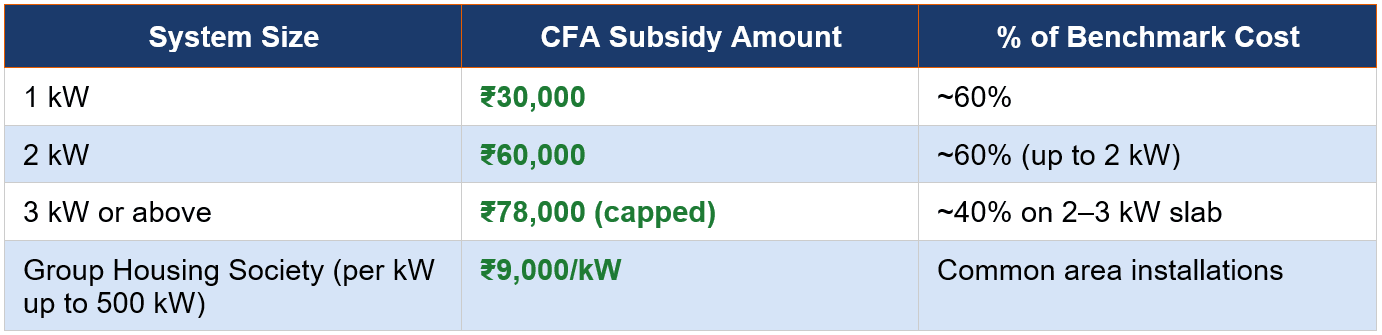
Central Subsidy Slab (Applicable Nationwide – 2026)
Who Is Eligible for Solar Subsidy in India 2026?
The PM Surya Ghar subsidy is available to residential consumers only—not commercial or industrial properties. You qualify if you meet all of the following conditions:
• You are an Indian citizen and own the property where the solar system will be installed.
• Your home has a valid, active grid-connected electricity connection from the local DISCOM.
• The rooftop is technically feasible for solar installation (shadow-free area, structurally sound).
• You apply through the official portal (pmsuryaghar.gov.in) and use only an empanelled/registered vendor.
• You have not previously availed of any other central solar subsidy for the same premises.
What About Housing Societies?
Group Housing Societies and Resident Welfare Associations (RWAs) are eligible for a separate CFA of ₹9,000 per kW for common-area installations up to 500 kW. This is ideal for apartment complexes with shared parking or terrace space.
Documents Required for Solar Subsidy Application
You do not need a long list of paperwork. Here is what you will typically need:
• Aadhaar card (for identity and address proof)
• Electricity bill (latest, showing consumer number and DISCOM details)
• Bank account details (for DBT credit—must match Aadhaar-linked account)
• Property ownership proof (in case of discrepancy with electricity bill name)
• Passport-size photograph
• Mobile number linked to Aadhaar (for OTP-based registration on the portal)
Vendors registered with your DISCOM will assist in completing the Project Completion Report (PCR) and uploading signed documents to the portal. Always insist on ALMM-compliant panels (Approved List of Models and Manufacturers) and BIS-certified equipment to meet MNRE technical standards.
How to Apply for Solar Subsidy: Step-by-Step Process
Follow these 8 steps to claim your subsidy under the PM Surya Ghar Muft Bijli Yojana 2026:
1. Register on the national portal at pmsuryaghar.gov.in. Select your state and electricity distribution company (DISCOM). No third party or vendor is allowed to register on your behalf.
2. Use the in-built benefits calculator on the portal to check the right system size for your monthly consumption and the subsidy amount you are eligible for.
3. Choose a vendor from the portal's list of DISCOM-empanelled solar installers. Cross-check vendor ratings before finalising.
4. The DISCOM conducts a technical feasibility study of your rooftop within approximately 15 days of application approval.
5. Once technically approved, your chosen vendor installs the on-grid rooftop solar system, ensuring ALMM-compliant panels and BIS-certified inverters.
6. Apply for net metering. Your DISCOM will install a bidirectional meter so excess power you generate is credited back to your account.
7. DISCOM inspection of the plant takes place. If everything meets MNRE guidelines, a commissioning certificate is issued.
8. Submit your bank details on the portal. The subsidy amount is typically credited to your account within 30 days of commissioning.

Net Metering Benefits: Earn Money from Your Solar Panels
Net metering (sometimes called 'नेट मीटरिंग' in Hindi materials) is a billing arrangement where the excess electricity your solar panels generate is fed back into the grid, and the units are credited against your future bills. In simple terms: your electricity meter runs backwards when your panels produce more power than you use.
With Indian electricity tariffs averaging ₹5–₹10 per unit (varying by state and consumer category), net metering can significantly accelerate your return on investment. A typical 3 kW system in a city like Jaipur or Nagpur—receiving 5–6 peak sun hours per day—can generate 12–15 units daily, potentially wiping out an electricity bill of ₹2,000–₹3,000 per month entirely.
State-wise net metering policies vary. Gujarat, Kerala, and Karnataka have particularly streamlined net metering approval processes. Delhi residents benefit from group net metering for housing societies via BSES Rajdhani and BSES Yamuna. Always check your DISCOM's current net metering tariff schedule, as the export rate may differ from the import rate.
Quick ROI Calculation: Is Solar Worth It in 2026?
Here is a real-world scenario for a typical Indian homeowner installing a 3 kW rooftop solar system:
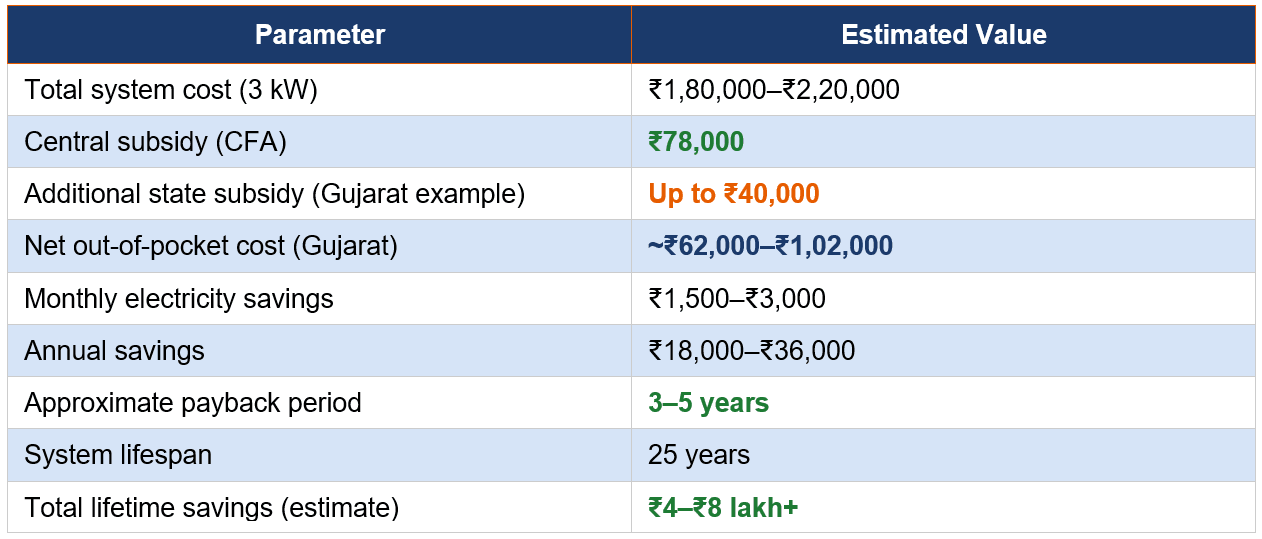
Note: All figures are indicative and will vary based on city, panel brand, roof type, electricity tariff, and actual sun hours. Consult a local empanelled installer for an accurate quote.
Recommended Solar Brands for Indian Homeowners 2026
Always choose panels that appear on the ALMM (Approved List of Models and Manufacturers) maintained by the Ministry of New and Renewable Energy. Some of the most trusted Indian solar brands include:
• Waaree Energies – India's largest solar panel manufacturer; wide dealer network
• Tata Power Solar – Trusted brand with strong warranty and after-sales support
• Adani Solar – High-efficiency panels; competitive pricing for large installations
• Loom Solar – Popular for residential rooftop systems; good customer service
• Vikram Solar – High-performance monocrystalline panels; BIS certified
• Premier Energies – Fast-growing; cost-effective for budget-conscious buyers
Ensure your inverter (the device that converts DC electricity from panels into usable AC power) is also BIS-certified and compatible with your DISCOM's net metering requirements.
Conclusion & Actionable Takeaways
2026 is arguably the best year for Indian homeowners to go solar. The PM Surya Ghar Muft Bijli Yojana provides up to ₹78,000 in central subsidy—directly into your bank account—and states like Gujarat sweeten the deal further with additional incentives. Net metering ensures your investment keeps earning even on cloudy days, and with payback periods of just 3–5 years on a 25-year asset, the financial case is hard to ignore.
Quick recap: The central CFA ranges from ₹30,000 (1 kW) to ₹78,000 (3 kW+). State top-ups can push total subsidies significantly higher in Gujarat, Rajasthan, Kerala, and Haryana. Always apply through pmsuryaghar.gov.in, use an ALMM-compliant system, and insist on a DISCOM-empanelled installer.
Ready to check your eligibility and calculate your exact savings? Visit the official PM Surya Ghar portal or get in touch with a Worex Solar advisor for a free, no-obligation rooftop assessment.
Frequently Asked Questions (FAQ Schema)
Q: What is the maximum solar subsidy I can get in India in 2026?
A: Under the PM Surya Ghar Muft Bijli Yojana, the maximum central subsidy is ₹78,000 for a 3 kW or larger on-grid rooftop system. States like Gujarat offer an additional ₹40,000 via the Surya Urja Rooftop Yojana, bringing total potential subsidy to ₹1,18,000 for eligible homeowners.
Q: Can I claim solar subsidy for a commercial property or shop?
A: No. The central CFA under PM Surya Ghar is available only for residential consumers. Commercial, industrial, and institutional properties do not qualify for this specific subsidy, though they may benefit from other MNRE schemes and net metering policies.
Q: How long does it take to receive the solar subsidy amount after installation?
A: Once you submit your bank details on the PM Surya Ghar portal after receiving the commissioning certificate from your DISCOM, the subsidy is typically credited to your account within 30 days. Processing times may vary by state.
Q: Can I get solar panels installed for free under PM Surya Ghar Yojana?
A: Not exactly. The scheme offers a subsidy of up to ₹78,000, which substantially reduces your cost but does not cover the full installation price. A 3 kW system typically costs ₹1,80,000–₹2,20,000 before subsidy. After applying the CFA (and any state incentive), your net cost will be lower but not zero.
Q: What is the deadline to apply for the PM Surya Ghar subsidy?
A: The scheme is approved and funded through FY 2026–27. However, applications are processed on a first-come, first-served basis against state quotas, so it is advisable to apply as soon as possible. The portal at pmsuryaghar.gov.in is the only official registration point.


