

PM Surya Ghar Subsidy vs Previous Solar Schemes: What Changed in 2026?
Ramesh from Bangalore applied for rooftop solar subsidy in 2022 under the old Grid-Connected Rooftop Solar Programme. His subsidy took 14 months to arrive, required 8 different document submissions, and involved multiple visits to the DISCOM office. His neighbor Priya installed solar in February 2026 under PM Surya Ghar. She received her ₹78,000 subsidy in just 52 days, completed everything online without visiting any office, and the entire process was transparent through a single portal.
If you're confused about how PM Surya Ghar differs from previous solar schemes, or wondering whether the new scheme is really better, this comprehensive guide breaks down every major change. Understanding these differences helps you appreciate why PM Surya Ghar is a game-changer for Indian homeowners and why now is the best time to go solar.
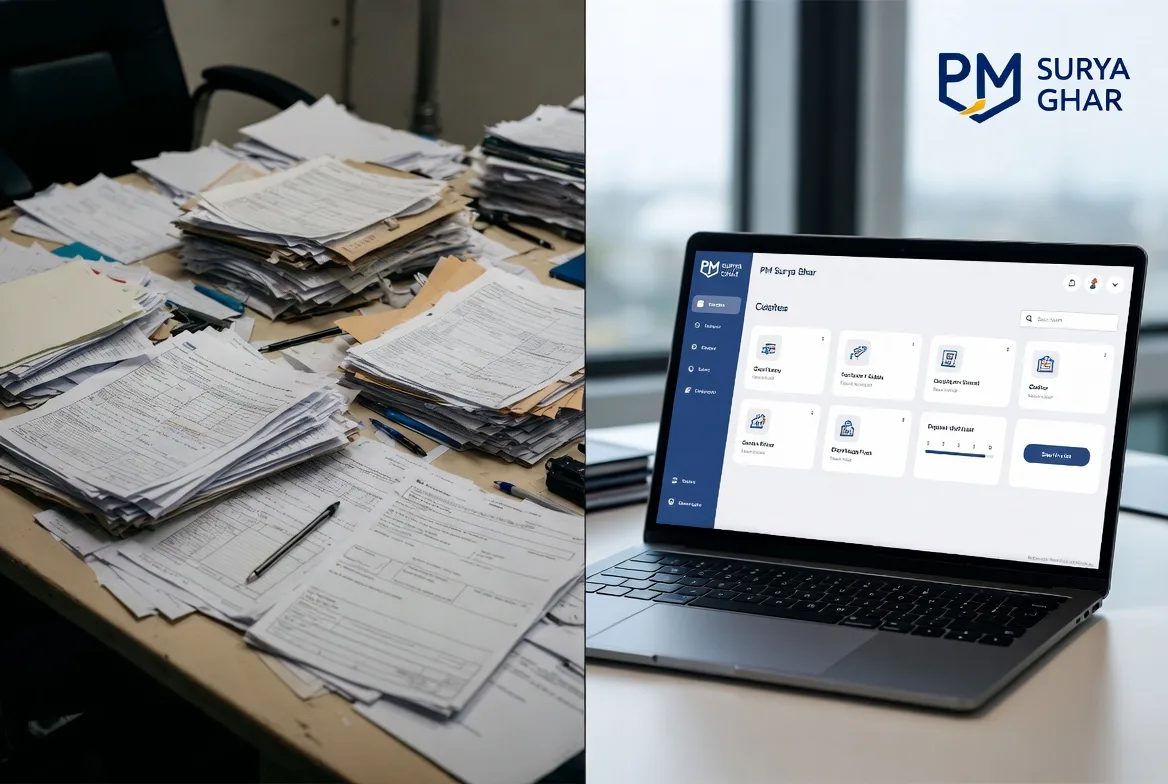
Understanding India's Solar Subsidy Journey
India's rooftop solar subsidy programs have evolved significantly over the past decade as the government refined policies based on ground realities and homeowner feedback.
Timeline of Solar Schemes in India
2014-2015: Initial Rooftop Solar Subsidy Scheme The first nationwide rooftop solar subsidy was launched with 30% capital subsidy for residential installations. However, limited awareness, complex procedures, and state-level implementation gaps meant very few homeowners actually benefited. Most subsidies went to institutional installations rather than individual homes.
2016-2019: Grid-Connected Rooftop Solar Programme Phase-I This scheme offered 30% subsidy for systems up to 3 kW and 20% for 3-10 kW systems. The subsidy structure incentivized smaller systems. Around 1.2 lakh residential installations happened nationwide, but processing times averaged 8-12 months, and many applicants faced rejections due to documentation issues.
2019-2022: Grid-Connected Rooftop Solar Programme Phase-II This was the immediate predecessor to PM Surya Ghar. It offered 40% subsidy for systems up to 3 kW and 20% for 3-10 kW systems. The subsidy amounts were better, but implementation remained fragmented. Each state had different portals, different processes, and widely varying approval timelines. Around 3.5 lakh installations were completed under this scheme.
February 2024 onwards: PM Surya Ghar Muft Bijli Yojana Announced in Union Budget 2024 and continuing strong in 2026, PM Surya Ghar represents a complete overhaul. The government set an ambitious target of 1 crore rooftop solar installations. By February 2026, over 45 lakh applications have been received with 28 lakh installations completed successfully.
Why PM Surya Ghar Was Needed
The previous schemes, despite good intentions, suffered from several critical problems:
Extremely long processing times: Homeowners waited 8-18 months for subsidy after installation. Many gave up or faced financial strain during the wait.
Inconsistent state implementation: Gujarat processed subsidies in 3 months while some northeastern states took over 2 years for the same application.
Complex documentation: Different DISCOMs demanded different documents. Even minor discrepancies led to rejections. Homeowners needed to submit 15-20 documents in some states.
Lack of transparency: No way to track application status. Homeowners had no idea whether their file was moving or stuck.
Installer dependency: Subsidy was often routed through installers, creating scope for malpractice. Many installers delayed subsidy applications to keep customers dependent.
Limited subsidy amounts: The earlier 40% subsidy for 2 kW worked out to only ₹48,000-₹56,000, which wasn't enough to significantly offset the ₹1.2-1.4 lakh cost.
PM Surya Ghar was designed specifically to address every single one of these pain points with systematic improvements.
PM Surya Ghar vs Grid-Connected Rooftop Solar Phase-II
Let's compare the last major scheme before PM Surya Ghar with the current scheme to understand the improvements.
Subsidy Amount Comparison
Grid-Connected Rooftop Solar Phase-II (2019-2024):
For systems up to 3 kW: 40% of benchmark cost (benchmark was ₹48,000-₹54,000 per kW depending on state)
Actual subsidy received: ₹19,200-₹21,600 per kW, totaling ₹57,600-₹64,800 for 3 kW system
For systems 3-10 kW: 20% of benchmark cost for capacity beyond 3 kW
For a 5 kW system: 40% for first 3 kW + 20% for remaining 2 kW = approximately ₹67,000-₹75,000 total
PM Surya Ghar Muft Bijli Yojana (2024-2026):
For first 2 kW: ₹30,000 per kW (total ₹60,000)
For next 1 kW (2-3 kW): ₹18,000 per kW
For 3 kW or larger: Maximum ₹78,000 flat amount
For a 5 kW system: Same ₹78,000 maximum
Real difference: Under the old scheme, a 3 kW system in Maharashtra got approximately ₹60,000 subsidy. Under PM Surya Ghar, the same system gets ₹78,000 - an increase of ₹18,000 or 30% more money.
However, the bigger change is standardization. Earlier, subsidy amounts varied by state based on different benchmark costs. Now, every Indian homeowner from Kashmir to Kanyakumari gets the exact same ₹78,000 for a 3 kW system. This eliminates the unfairness where a Gujarat homeowner got ₹64,000 while a Bihar homeowner got ₹58,000 for identical installations.
Application Process Changes
Old Scheme Process (Grid-Connected Rooftop Solar Phase-II):
Step 1: Visit state nodal agency website (different for each state)
Step 2: Download and fill PDF application form manually
Step 3: Get physical signatures from installer, electricity board engineer, and sometimes local authority
Step 4: Submit physical documents at DISCOM office or upload low-quality scans on state portal
Step 5: Wait for feasibility approval (no way to track status)
Step 6: Install system after approval
Step 7: Request DISCOM inspection through written application
Step 8: After inspection, submit separate subsidy claim form with 12-15 supporting documents
Step 9: Wait for manual file processing at state and central level
Step 10: Subsidy credited after multiple levels of approval (8-18 months)
Different states had 15-30 different portal designs, forms, and requirements. A homeowner moving from Delhi to Bangalore had to learn an entirely new process.
PM Surya Ghar Process (2024-2026):
Step 1: Register on single national portal pmsuryaghar.gov.in with Aadhaar and consumer number
Step 2: Submit online feasibility application through same portal
Step 3: Receive feasibility approval digitally (7-15 days)
Step 4: Install through MNRE-empaneled vendor
Step 5: Upload installation photos and documents on portal
Step 6: Request inspection through same portal
Step 7: DISCOM inspection happens, certificate uploaded by DISCOM on portal
Step 8: Subsidy automatically processed (no separate application needed)
Step 9: Direct bank transfer within 30-90 days
Key differences:
- One national portal vs 30+ different state portals
- Everything digital vs physical documents and office visits
- Automatic subsidy processing vs manual claim submission
- Real-time status tracking vs black box process
- Aadhaar-based authentication vs multiple verification layers
The new process is so simple that senior citizens and non-tech-savvy homeowners can complete it independently without paying agents ₹5,000-₹10,000 for "documentation services."
Approval Timeline Differences
Old Scheme Timelines:
Registration to feasibility: 15-45 days (varied widely by state)
Installation to inspection: 20-60 days (inspections often delayed)
Inspection to subsidy disbursement: 4-14 months (the biggest bottleneck)
Total average timeline: 6-18 months from application to subsidy receipt
In well-performing states like Gujarat and Karnataka, the process took 4-6 months. In states with DISCOM inefficiencies, it stretched beyond 18 months. Some 2020-2021 applications from UP and Bihar were still pending in 2023.
PM Surya Ghar Timelines:
Registration to feasibility: 5-15 days (consistent across India)
Installation to inspection: 7-20 days (DISCOMs mandated to respond faster)
Inspection to subsidy credit: 20-60 days (target is 30 days)
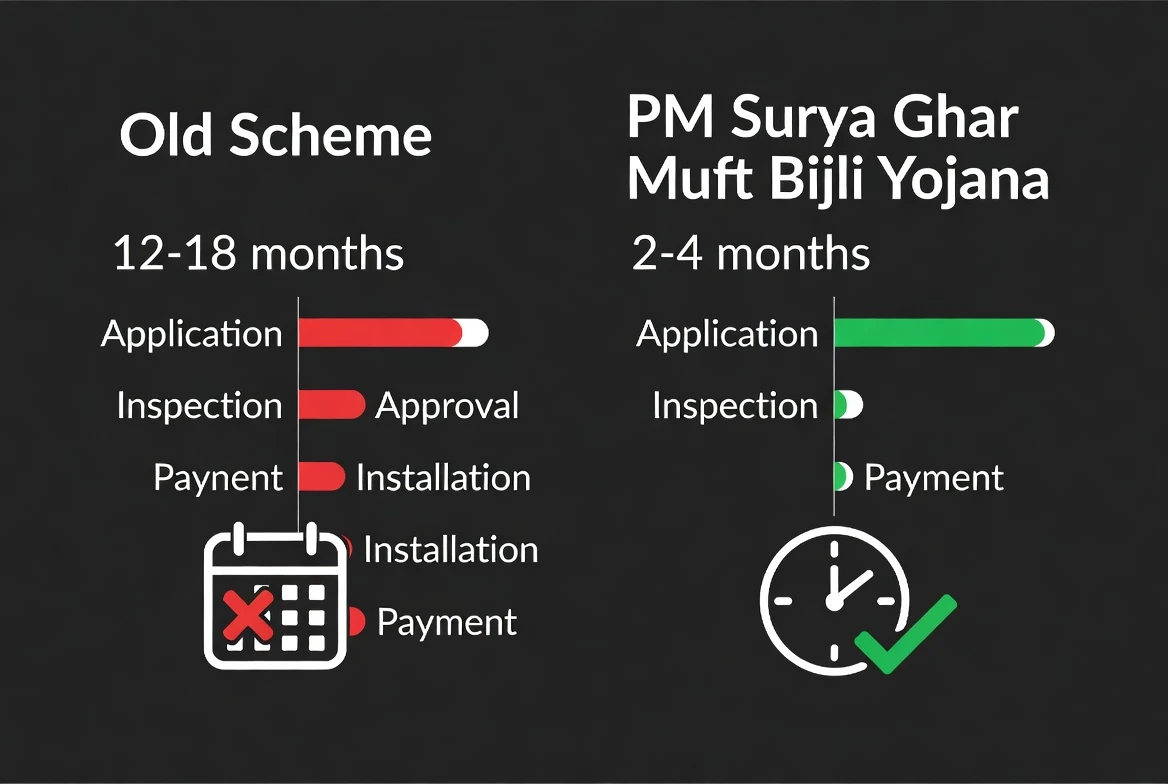
Total average timeline: 2-4 months from application to subsidy receipt
As of February 2026, the national average timeline is 68 days from registration to subsidy credit. States like Gujarat, Rajasthan, and Karnataka achieve 45-55 days. Even slower states like Jharkhand and Odisha complete the process in 75-90 days.
The improvement comes from automated workflows, single-point accountability, and real-time monitoring by MNRE. Every delay beyond standard timelines now triggers automatic escalation to senior officials.
Major Improvements in PM Surya Ghar Scheme
Beyond just faster processing and higher subsidies, PM Surya Ghar introduced several structural improvements that make it genuinely transformative.
Single National Portal vs Multiple State Portals
Under Previous Schemes: Each state had its own portal with different user interfaces, different documentation requirements, and different processing workflows. If you owned properties in two states and wanted solar at both, you dealt with two completely different systems.
Gujarat had one of the best portals with decent user experience. States like UP, Bihar, and Jharkhand had barely functional portals that crashed frequently, accepted only specific file formats, and had zero customer support.
Installers needed state-specific expertise. A Delhi-based installer couldn't easily work in Maharashtra because they didn't understand the Maharashtra portal and documentation nuances.
Under PM Surya Ghar: One unified national portal for all states. Whether you're in Srinagar or Chennai, the application process is identical. The same login credentials work everywhere.
The portal is mobile-responsive, supports multiple languages (Hindi, English, and 10 regional languages), and has built-in help guides and video tutorials.
Most importantly, the portal integrates directly with DISCOM databases. When you enter your consumer number, it automatically fetches your name, address, and sanctioned load. No manual data entry, no typos, no mismatches.
The portal shows real-time status: "Application Submitted," "Feasibility Under Review," "Feasibility Approved," "Installation Completed," "Inspection Scheduled," "Inspection Passed," "Subsidy Processing," "Subsidy Disbursed."
You can download all certificates and documents from the portal anytime. No need to chase DISCOM offices for paperwork.
Direct Bank Transfer vs Installer-Routed Subsidy
This is perhaps the most significant anti-corruption improvement in PM Surya Ghar.
Under Previous Schemes: In many states, the subsidy was paid to the installer, not the homeowner. The installer was supposed to pass it on to you by reducing your bill. This created massive scope for malpractice.
Unethical installers would quote ₹1,80,000 for a system, receive ₹60,000 subsidy from the government, but still charge you the full ₹1,80,000. You never saw the subsidy money.
Some installers delayed subsidy applications intentionally to keep customers dependent. They'd say "pay me full amount now, I'll process subsidy later" and then take 18-24 months.
Homeowners had zero transparency into whether the installer even applied for subsidy or pocketed the money claiming "subsidy got rejected."
Under PM Surya Ghar: Subsidy is ALWAYS paid directly to the homeowner's Aadhaar-linked bank account via Direct Benefit Transfer (DBT). The installer never touches subsidy money.
You pay the installer full system cost upfront (minus any advance discount they offer). Then, separately, the government credits subsidy to your account.
This eliminates installer fraud completely. If an installer now asks you to "pay less because subsidy will come," that's a red flag—it means they're planning to claim your subsidy fraudulently.
The transparency also empowers homeowners to negotiate better. Earlier, installers would inflate costs claiming "this includes subsidy processing." Now, system cost and subsidy are completely separate, making pricing more honest.
Simplified Documentation Requirements
Under Previous Schemes: Different states required 12-25 different documents. Common requirements included:
Property tax receipt, electricity bill, Aadhaar card, PAN card, bank passbook, canceled cheque, property ownership proof (sale deed/registry), NOC from society/landlord, structural stability certificate from engineer, roof area certificate, building plan approval, self-declaration affidavit, installer agreement, panel datasheet, inverter datasheet, mounting structure specifications, installation photographs from 4 different angles, commissioning report, meter reading before installation, meter reading after installation.
Every document needed notarization or gazetted officer attestation in some states. One missing or mismatched document? Application rejected. Start over.
Under PM Surya Ghar: Only 6 mandatory documents:
- Aadhaar card (verified via OTP, no upload needed)
- Recent electricity bill (verified automatically from DISCOM database)
- Bank account details (Aadhaar-seeded)
- PAN card (for tax purposes)
- Property ownership proof (one document: tax receipt OR sale deed OR patta)
- Installation photographs (uploaded by installer post-installation)
No notarization required. No attestation needed. Digital copies accepted. The portal automatically validates Aadhaar and bank account linkage, eliminating fake applications.
For rented properties, one additional document: landlord NOC letter (not even notarized, just a signed letter).
The documentation burden has reduced by 60-70%, making the process accessible to rural homeowners and senior citizens who struggled with the previous complex requirements.
Subsidy Calculation: Old vs New Method
The calculation methodology changed significantly, affecting how much money you actually receive.
How Subsidy Was Calculated Before
Under Grid-Connected Rooftop Solar Phase-II, subsidy was based on "benchmark costs" set by MNRE for each state. This was complicated:
Benchmark cost: MNRE decided that solar installation should cost ₹48,000-₹54,000 per kW (varied by state based on local market assessment).
Subsidy percentage: 40% for first 3 kW, 20% for 3-10 kW.
Example calculation for 3 kW system in Maharashtra: Benchmark cost: ₹51,000 per kW Total benchmark: ₹51,000 × 3 = ₹1,53,000 Subsidy at 40%: ₹1,53,000 × 40% = ₹61,200
But here's the catch: If your actual installation cost was ₹1,80,000 (higher than benchmark due to premium panels or difficult installation), you still only got subsidy on the ₹1,53,000 benchmark, not your actual cost.
If your actual cost was ₹1,40,000 (lower due to good negotiation or cheap components), you got subsidy on ₹1,40,000, not the full benchmark.
This created confusion. Homeowners didn't know whether subsidy would be calculated on their actual bill or the benchmark amount until after installation.
Worst part: Benchmark costs weren't updated frequently. A benchmark set in 2019 at ₹48,000/kW became outdated by 2022 when actual costs rose to ₹60,000/kW due to GST changes and component price increases. Homeowners received lower subsidy as a percentage of their actual investment.
How PM Surya Ghar Calculates Subsidy Now
PM Surya Ghar uses a flat, simple calculation independent of actual installation cost or benchmark cost:
Fixed subsidy per kW: First 2 kW: ₹30,000 per kW Next 1 kW (from 2-3 kW): ₹18,000 per kW
Maximum cap: ₹78,000 regardless of system size beyond 3 kW
Example calculations:
1 kW system: ₹30,000 subsidy (₹30,000 × 1) Actual cost: ₹65,000 Subsidy as percentage: 46%
2 kW system: ₹60,000 subsidy (₹30,000 × 2) Actual cost: ₹1,20,000 Subsidy as percentage: 50%
3 kW system: ₹78,000 subsidy (₹60,000 + ₹18,000) Actual cost: ₹1,75,000 Subsidy as percentage: 45%
5 kW system: ₹78,000 subsidy (same maximum) Actual cost: ₹2,75,000 Subsidy as percentage: 28%
Key advantages of new method:
Predictable: You know exactly how much subsidy you'll get before applying. No confusion about benchmarks or percentages.
Fair: Whether you install cheap panels or premium panels, pay ₹1,50,000 or ₹2,00,000, the subsidy is fixed. This encourages quality over cost-cutting.
Inflation-proof: Since subsidy is a fixed rupee amount, it doesn't get eroded when installation costs increase. MNRE can update the fixed amounts periodically without changing the entire calculation formula.
Simplified disputes: Earlier, homeowners disputed benchmark costs if they felt their state's benchmark was too low. Now, no benchmark means no disputes.
The new method heavily favors smaller 2-3 kW systems (50% subsidy) while giving modest support to larger systems (28% subsidy for 5 kW). This aligns with the government's goal of reaching maximum number of households rather than subsidizing luxury large installations.
Eligibility Criteria Changes
Eligibility has become more inclusive under PM Surya Ghar while maintaining necessary safeguards.
Who Could Apply Before
Under Grid-Connected Rooftop Solar Phase-II, eligibility varied by state but generally included:
Must own the property: Tenants couldn't apply even with landlord permission in most states. This excluded millions of urban renters.
Must have individual electricity meter: Society or shared meter connections weren't eligible. This excluded many apartment complexes with common billing.
Minimum roof ownership: In apartments, you needed clear rooftop ownership rights. If terrace was common property, you couldn't apply even with RWA approval in many states.
No previous subsidy: If you ever received any solar subsidy at that property, you were permanently ineligible. Even if your old 1 kW system from 2015 failed and you wanted to reinstall, you couldn't get subsidy.
System size limits: Some states had upper limits of 3 kW for residential category. Larger homes couldn't install 5-10 kW systems under subsidy.
Caste/income certificates: Some state-specific additional subsidies required SC/ST certificates or income certificates, creating documentation burden.
These restrictions meant many genuine homeowners who wanted solar couldn't access subsidies due to technicalities.
Who Can Apply Under PM Surya Ghar
PM Surya Ghar made eligibility simpler and more inclusive:
Property ownership OR landlord consent: Tenants can now apply if they have landlord's written permission and the electricity connection is in their name. This opens up subsidy to urban renters planning long-term stays.
Individual AND society meters accepted: Apartment residents with common society meters can apply through the society for rooftop solar, with subsidy distributed among members. Virtual net metering provisions are being tested.
Common terrace installations: If your apartment complex wants solar on common terrace, the society can apply collectively. Subsidy is divided among participating members based on electricity connection capacity.
Replaced systems eligible: If you installed solar in 2015 without subsidy and now want to upgrade or replace, you can apply under PM Surya Ghar. The "no previous subsidy" clause only applies if you received subsidy at that exact premises.
No system size upper limit: You can install 1 kW to 10 kW or even larger systems. Subsidy maxes out at ₹78,000, but there's no restriction on installing larger capacity at your own cost.
No income certificate required: Unlike some previous state schemes that had income limits, PM Surya Ghar has no income restrictions. Rich or middle-class, everyone gets the same subsidy.
Simplified caste/ownership proofs: Only basic property ownership proof needed. No need for detailed revenue records or tehsil certificates that rural homeowners struggled to obtain.
The only strict requirements remaining: Indian citizen, residential electricity connection, ALMM-certified panels, MNRE-empaneled installer. These are necessary quality and authenticity safeguards.
Net Metering Policy Evolution
Net metering rules have also improved significantly under PM Surya Ghar framework.
Net Metering Under Old Schemes
Previous rooftop solar schemes left net metering entirely to state electricity regulatory commissions. This created huge inconsistencies:
Net metering caps: Some states limited net metering to 50% of your sanctioned load. If your home had 5 kW sanctioned load, you could only install maximum 2.5 kW solar with net metering.
Settlement periods: Some states settled net metering monthly, others quarterly, some annually. Monthly settlement was bad—surplus generation in April got wasted if you couldn't use it in May.
Rollover policies: In states with monthly settlement, surplus units expired. If you generated 100 extra units in summer, they vanished at month-end with no compensation.
Export tariff: States that didn't allow banking paid ₹2-3 per unit for surplus solar export while charging ₹6-8 for grid import. Homeowners lost money on excess generation.
Metering charges: Net meter costs ranged from free in some states to ₹25,000 in others. No standardization.
Processing time: Net metering approval took 10-60 days depending on state. Some DISCOMs deliberately delayed to discourage rooftop solar.
These inconsistent policies confused homeowners. Someone in Karnataka enjoyed annual settlement with full rollover, while their cousin in Tamil Nadu faced monthly settlement with expired credits.
Improved Net Metering Under PM Surya Ghar
PM Surya Ghar implementation includes strong recommendations to DISCOMs for uniform net metering:
Standardized caps: Recommended net metering up to sanctioned load or 10 kW (whichever is lower) for residential. This means most homes can install their optimal system size.
Annual settlement mandatory: All states now required to offer annual settlement period. Your surplus April generation compensates for deficit December consumption.
Fair rollover: At year-end, if you have surplus units, you get credit at ₹2.50-4 per unit (varies by state but better than before). Previously many states gave zero compensation.
Reduced metering charges: MNRE recommended metering charges of ₹5,000-10,000 maximum. States are complying to encourage PM Surya Ghar installations.
Faster processing: Target timeline of 15 days for net metering approval. DISCOMs that delay face performance penalties from MNRE.
Simplified application: Net metering application integrated into PM Surya Ghar portal. One application covers both subsidy and net metering, no separate forms.
Gross metering option: For systems above 10 kW, gross metering available where you sell all generation to DISCOM at feed-in tariff rates.
These improvements mean better economics. Earlier, homeowners had to size systems very conservatively to avoid wasting surplus generation. Now, you can install larger systems knowing annual settlement will compensate for seasonal variations.
Processing Time and Disbursement Changes
The speed improvement in PM Surya Ghar is remarkable when you compare actual homeowner experiences.
Previous Scheme Delays and Issues
Real examples from Grid-Connected Rooftop Solar Phase-II applications (2020-2023):
Case 1 - Pune, Maharashtra: Application date: March 2021 Installation completed: June 2021 Subsidy received: January 2023 Duration: 22 months Issue: File stuck at state nodal agency for "technical verification" with no updates. Only received subsidy after Twitter complaint tagged Chief Minister's office.
Case 2 - Patna, Bihar: Application date: August 2020 Installation completed: November 2020 Subsidy received: Still pending as of December 2023 (likely never received) Duration: 36+ months Issue: DISCOM claimed "incomplete documentation" but never specified which documents were missing. Homeowner gave up after 15 follow-up visits.
Case 3 - Ahmedabad, Gujarat: Application date: January 2022 Installation completed: March 2022 Subsidy received: July 2022 Duration: 6 months Issue: Even in best-performing Gujarat, the process took 6 months with multiple status-check phone calls required.
Case 4 - Lucknow, UP: Application date: April 2021 Installation completed: July 2021 Subsidy received: March 2023 Duration: 23 months Issue: Every document was asked for 2-3 times. Homeowner had to submit property papers thrice because "first copies were not clear" despite being high-quality scans.
The common pattern: Zero transparency, no accountability, and homeowners completely dependent on DISCOM and nodal agency mercy.
Many homeowners reported spending ₹5,000-15,000 on repeated visits, photocopies, affidavits, and "facilitation fees" to agents who promised to "speed up the file."
PM Surya Ghar Timeline Improvements
Real examples from PM Surya Ghar applications (2024-2026):
Case 1 - Jaipur, Rajasthan: Registration: January 15, 2026 Feasibility approval: January 22, 2026 (7 days) Installation completed: February 10, 2026 Inspection: February 15, 2026 Subsidy credited: March 12, 2026 Total duration: 56 days from registration to subsidy receipt Process: Completely online, zero office visits, tracked everything on portal
Case 2 - Kolkata, West Bengal: Registration: December 1, 2025 Feasibility approval: December 18, 2025 (17 days) Installation completed: January 8, 2026 Inspection: January 20, 2026 (some delay due to weekend) Subsidy credited: February 28, 2026 Total duration: 89 days Process: All digital, received automated SMS at each stage
Case 3 - Bhopal, Madhya Pradesh: Registration: November 10, 2025 Feasibility approval: November 18, 2025 (8 days) Installation completed: December 5, 2025 Inspection: December 12, 2025 Subsidy credited: January 25, 2026 Total duration: 76 days Process: One document reupload requested (clearer property photo), otherwise smooth
Case 4 - Mumbai, Maharashtra: Registration: January 5, 2026 Feasibility approval: January 20, 2026 (15 days, slower due to high volume) Installation completed: February 8, 2026 Inspection: February 15, 2026 Subsidy credited: March 18, 2026 Total duration: 72 days Process: Portal glitched once during upload, but helpline resolved within 24 hours
Average PM Surya Ghar timeline nationally: 65-75 days from registration to subsidy credit as of February 2026.
The improvement from 12-18 months to 2-3 months is transformative. Homeowners can now plan finances properly, knowing exactly when subsidy will arrive.
What Happened to Applications Under Old Schemes?
This is a common concern for people who applied under previous schemes.
Pending Applications Status
When PM Surya Ghar launched in February 2024, approximately 1.8 lakh applications were pending under the old Grid-Connected Rooftop Solar Phase-II scheme. The government took two actions:
For approved pending installations: If your feasibility was approved and installation was completed but subsidy not disbursed, your case was automatically migrated to PM Surya Ghar for faster processing. You didn't need to reapply. These cases received priority and most were cleared by August-September 2024.
For incomplete applications: If your feasibility was pending or you hadn't completed installation, you were given the option to withdraw and reapply under PM Surya Ghar OR continue with the old scheme. The old scheme remained open until March 2025 for these legacy cases.
Most homeowners chose to withdraw and reapply under PM Surya Ghar because:
- Higher subsidy (₹78,000 vs ₹60,000-65,000)
- Faster processing
- Better portal experience
- Direct bank transfer
As of February 2026, all old scheme applications have been closed. If you had a pending application that you never completed, you need to submit a fresh application under PM Surya Ghar now.
Can You Reapply Under PM Surya Ghar?
If you received subsidy under the old scheme: You CANNOT reapply for the same property. The eligibility check is strict—one subsidy per electricity connection per lifetime.
However, you can apply for a different property. If you received subsidy for your Delhi home in 2021, you can now apply for your new Bangalore flat under PM Surya Ghar.
If you installed solar WITHOUT subsidy: You CAN now apply under PM Surya Ghar. Many homeowners installed solar in 2019-2021 without applying for subsidy (due to complex procedures or because they were told they didn't qualify). If you never received any government subsidy for rooftop solar at your current address, you're eligible.
If your old application was rejected: You CAN reapply. Previous rejection doesn't make you permanently ineligible. Just ensure you address whatever caused the rejection (wrong documents, non-ALMM panels, etc.) before reapplying.
If you withdrew pending application: You CAN apply fresh under PM Surya Ghar. Withdrawal means your old application is canceled, making you eligible again.
The system checks subsidy history by consumer number and Aadhaar. If both show no previous subsidy received, you're clear to apply.
Which Scheme is Better for You?
This question is now academic since old schemes are closed, but understanding the comparison helps you appreciate PM Surya Ghar's value.
For 99% of homeowners, PM Surya Ghar is better in every way:
Higher subsidy: ₹78,000 vs ₹58,000-65,000 for 3 kW systems
Faster processing: 2-3 months vs 10-18 months
Better transparency: Real-time tracking vs black box
Simplified process: 6 documents vs 15-20 documents
Direct payment: Your bank account vs installer-routed
National uniformity: Same process everywhere vs state variations
Better net metering: Annual settlement vs monthly in many states
No corruption scope: Transparent workflows vs agent-dependent
The only scenario where old scheme might have been better: If you lived in a state that offered additional state subsidy on top of central subsidy (like Gujarat's Suryashakti Yojana which gave ₹10,000 extra per kW). However, most of these state schemes now work alongside PM Surya Ghar rather than being replaced by it.
For anyone applying today (February 2026), PM Surya Ghar is the only option and it's significantly superior to anything that came before.
Conclusion
PM Surya Ghar represents the biggest improvement in India's rooftop solar journey. Compared to previous schemes, it offers ₹18,000-20,000 higher subsidy for typical 3 kW systems, reduces processing time from 12-18 months to just 2-3 months, eliminates documentation complexity from 15-20 documents to just 6, and ensures transparent, corruption-free processing through a unified national portal with direct bank transfer.
The scheme has addressed every major complaint homeowners had with previous programs—long delays, confusing state-level variations, installer dependency, lack of transparency, and complex paperwork. If you delayed going solar due to horror stories about subsidy delays under old schemes, those concerns are now largely resolved.
With 45 lakh applications already processed successfully and average subsidy disbursement happening in 65-75 days nationally, PM Surya Ghar is delivering on its promises. This is the best time in India's solar history to install rooftop solar as a residential homeowner.
Ready to take advantage of this improved scheme? Visit pmsuryaghar.gov.in today, register in 15 minutes, and join the 28 lakh Indian households already generating free electricity while saving ₹3,000-5,000 monthly on power bills.


