

Solar Subsidy for Farmers in India: Complete Guide to Schemes and Benefits (2026)
For decades, Indian farmers have faced two major hurdles: rising diesel prices for irrigation and erratic electricity supply that often forces them to work in their fields at midnight. However, 2026 marks a turning point. With the extension and expansion of the PM-KUSUM Scheme, the Government of India is now offering a massive solar subsidy for farmers, making solar-powered farming more affordable than ever.
Whether you are a small landholder in Punjab or a large-scale farmer in Maharashtra, understanding the available schemes can help you reduce your input costs by nearly 90%. In this guide, we break down everything you need to know about solar subsidies, costs in ₹ (Rupees), and the application process to help you transition to "Saur Urja" (Solar Energy).
PM-KUSUM Scheme 2026: The Backbone of Agricultural Solar Subsidy
The Pradhan Mantri Kisan Urja Suraksha evam Utthaan Mahabhiyan (PM-KUSUM) is the primary national program designed to "de-dieselize" the farm sector. By March 2026, the government aims to add over 34,800 MW of solar capacity through three key components.
Component A: Earning from Barren Land (0.5 MW to 2 MW)
If you have barren or uncultivable land, you can set up small solar power plants.
- Benefit: You can sell the electricity generated to your local DISCOM at a fixed price.
- Income: Farmers can earn between ₹25,000 to ₹65,000 per acre annually for 25 years.
- Note: If you can't afford the setup, you can lease your land to developers and receive a monthly rent.
Component B: Standalone Solar Pumps (Off-Grid)
This is the most popular part of the solar subsidy for farmers. It replaces diesel pumps with solar-powered versions.
- Capacity: Up to 7.5 HP (pumps up to 15 HP are supported in specific hilly regions).
- Subsidy: The Central and State governments together cover 60% to 90% of the cost.
Component C: Solarizing Existing Grid-Connected Pumps
If you already have an electric pump, you can "solarize" it.
- Dual Benefit: Use solar power to run your pump during the day and sell the excess electricity back to the grid.
- Savings: This can effectively reduce your electricity bill to zero and create a secondary income stream.
How Much Subsidy Can You Get? (The 60% to 90% Rule)
In 2026, the cost-sharing model for a solar pump in India typically looks like this:
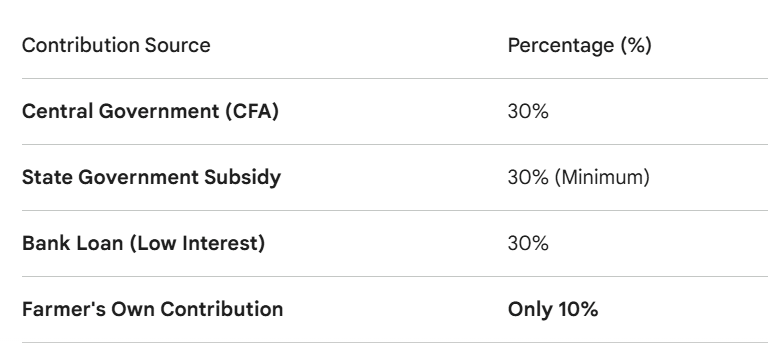
Important Note: In North-Eastern states, Hilly regions (HP, Uttarakhand, J&K), and Islands, the Central Government provides 50% subsidy, often meaning the farmer pays almost nothing out of pocket. For more on general costs, check our 5kW Solar System Cost India 2026 guide.
Top Benefits of Solar for Indian Farmers
- Daytime Irrigation: No more working in the fields at night. Solar provides power when the sun is out, matching your natural working hours.
- Diesel Savings: Replacing a 5HP diesel pump can save you roughly ₹50,000–₹70,000 per year in fuel and maintenance costs.
- Low Maintenance: Unlike diesel engines, solar panels have no moving parts. A quick wash once a week is all they need. (Learn more at Why Are My Solar Panels Not Generating Enough Power?)
- Agrivoltaics (Agri-PV): In 2026, the "Stilt-mounted" solar model is becoming popular. Panels are placed 8–10 feet high, allowing you to grow shade-loving crops like ginger or leafy vegetables beneath them.
State-wise Additional Subsidies
While PM-KUSUM is a central scheme, several states offer a "Top-up" to make it even cheaper:
- Haryana (HAREDA): Offers a total of 75% subsidy on solar pumps for farmers.
- Maharashtra: The Magel Tyala Saur Krushi Pump Yojana has allocated over ₹15,000 crore to ensure every applicant gets a pump.
- Rajasthan: Leads the country with over 85,000 installations, focusing on high-efficiency monocrystalline technology. (Read about Monocrystalline vs Polycrystalline panels).
Step-by-Step Guide: How to Apply Online
- Visit the Official Portal: Only use pmkusum.mnre.gov.in or your state's specific portal (e.g., Kusum Haryana).
- Registration: Enter your Aadhaar number and mobile number. Aadhaar authentication is now mandatory as of March 2026.
- Upload Documents: * Aadhaar Card
- Land Records (Khasra-Khatauni)
- Bank Passbook (linked to Aadhaar for DBT)
- Passport Size Photo
- Vendor Selection: Choose an MNRE-approved vendor (e.g., Tata Power Solar, Waaree, or Adani).
- Payment: Pay your 10% share online. The vendor will then install the system within 30–60 days.
Conclusion: Secure Your Energy Independence
The solar subsidy for farmers in India is a golden opportunity to turn your farm into a powerhouse. By switching to solar, you are not just saving money on diesel and electricity; you are securing a reliable, clean source of energy for the next 25 years.
With the PM-KUSUM 2026 deadline approaching, now is the best time to apply.
Next Steps for You:
- Calculate your potential savings based on your current diesel usage.
- Check your eligibility on your state’s renewable energy portal.
- Would you like me to find the direct application link for your specific state?
Frequently Asked Questions
Q: Can I apply for a solar subsidy if I don't own the land?
A: No, you must have valid land ownership documents (Khasra/Khatauni) or a long-term lease agreement registered in your name.
Q: What is the maximum HP of a solar pump covered under subsidy?
A: The standard subsidy is for pumps up to 7.5 HP. You can install higher capacity (up to 15 HP), but the subsidy amount is capped at the 7.5 HP benchmark.
Q: How long do solar panels on a farm last?
A: Most Tier-1 brands like Tata and Waaree offer a 25-year performance warranty.


